Note: This research is now part of my book Masters of the Longsword (2026). Changes are listed in the changelog at the end.
A Data-Driven Study of Occupations, Origins, and Social Space (c. 1500–1700)
All data compilation, transcription, and analysis in this article are © Kilian Theil (2026), released under CC BY‑NC-SA 4.0. Please attribute when using this work.
For several centuries, the Marxbrüder shaped the martial culture of the Holy Roman Empire. Yet despite their prominence, our understanding of who these fencers were, where they came from, and how they moved through the social and urban spaces of their time has remained surprisingly fragmentary. Much of the existing narrative rests on scattered references, partial transcriptions, and long-standing assumptions – some of which prove far less secure when examined closely.
This study offers the first comprehensive reconstruction of the Marxbrüder across their entire documented tenure. Drawing on both the well-known Medel Fechtbuch and a second, largely overlooked Frankfurt chronicle covering 1583–1716, I assembled the most complete dataset of Marxbrüder masters to date: 363 individuals, their occupations, hometowns, and documented activities. This combined source base allows us, for the first time, to trace long-term demographic patterns, occupational clusters, geographic centers, and the shifting social profile of the brotherhood.
Part I maps the people – using data science to test claims about guild affiliations, regional origins, and the rise and decline of the Marxbrüder over time. Part II turns from numbers to places, examining the physical and symbolic spaces in which the brotherhood appeared, gathered, and was remembered. As we will see, several sites long associated with the Marxbrüder rest on surprisingly shaky ground, while others – such as the Krachbein and the Schelmengarten – emerge with new clarity.
Together, these two perspectives reveal a far more nuanced picture of the Marxbrüder: not merely a fencing society, but a mobile, socially diverse, and regionally interconnected network whose presence shaped both the demographic fabric and the urban memory of early modern Frankfurt.
Part I – Mapping People: Creating and Analyzing the Most Comprehensive Marxbrüder Dataset to Date 📊
The Red Record Book of the Marxbrüder (1583–1716)
Central to this study is the Red Record Book, the Marxbrüder’s continuous register of masters and captains from 1583 to 1716. It lies at Institut für Stadtgeschichte (ISG) Frankfurt under signature H.18.02 (Marxbrüder und Federfechter: Urkunden und Akten des Rates) Nr. 13.
Before turning to the manuscript itself, it is worth noting the limited prior scholarship on this source. Sabine Kindel’s lecture1 “Die Marxbrüder – Spuren des fechtenden Handwerks in Frankfurt a. M.” provides the first structured overview of the Red Record Book and introduces a foundational sociodemographic analysis. Prior to her, Peter Maar’s 1961 diploma thesis examined roughly ten percent of the entries, focusing on masters from Nuremberg.2 The present study builds on these contributions by offering the first complete transcription and quantitative evaluation of the entire manuscript.
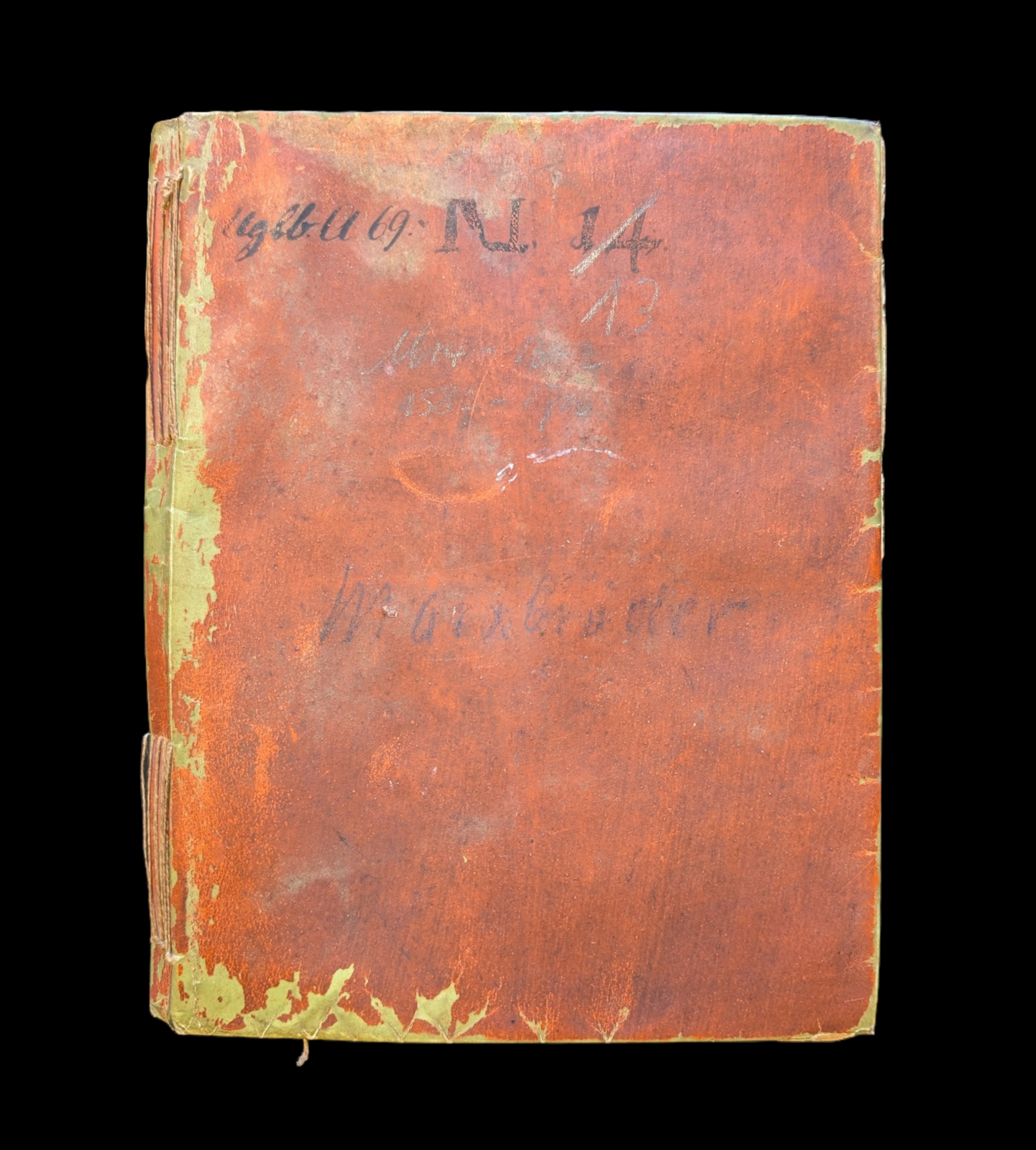
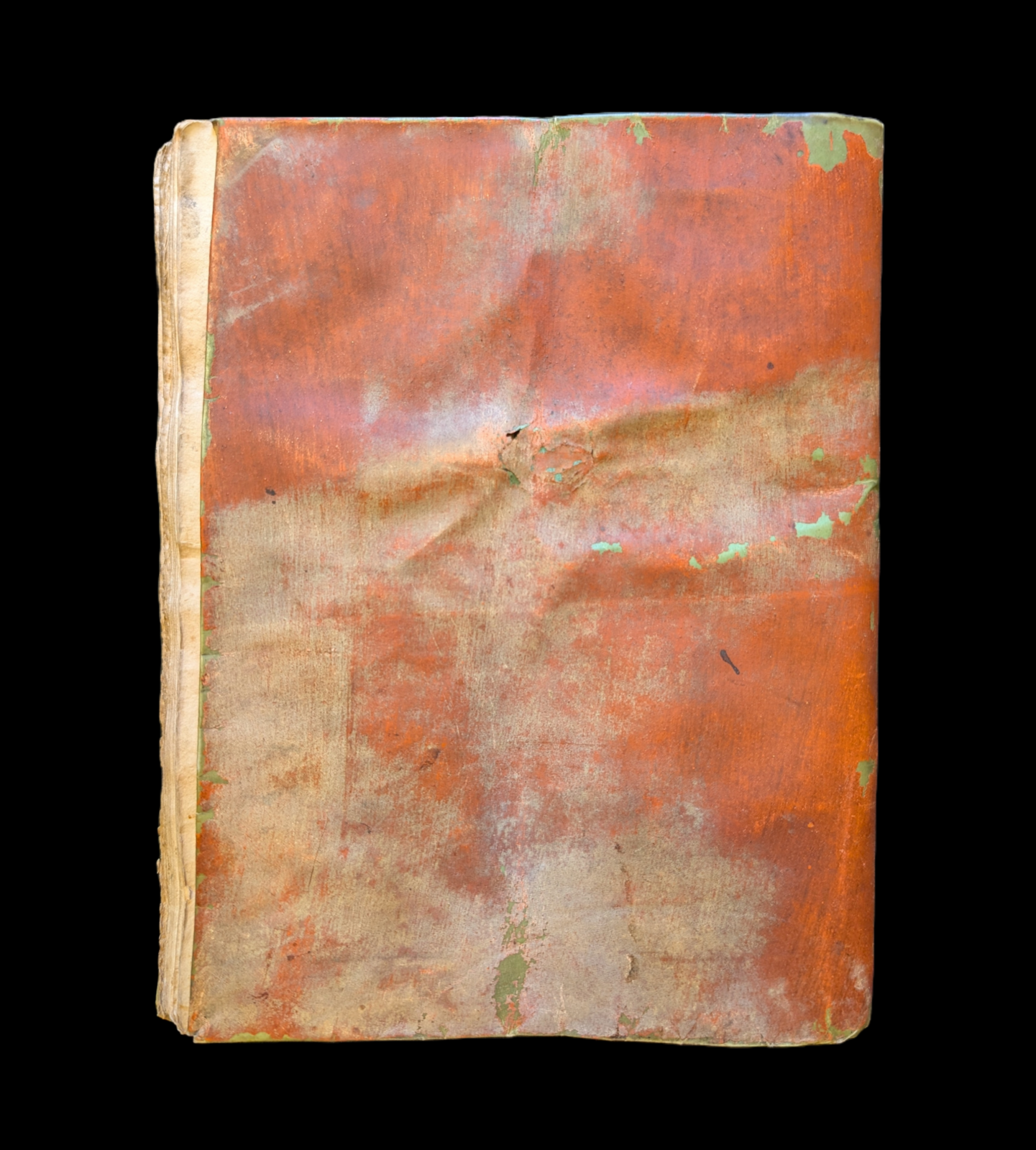
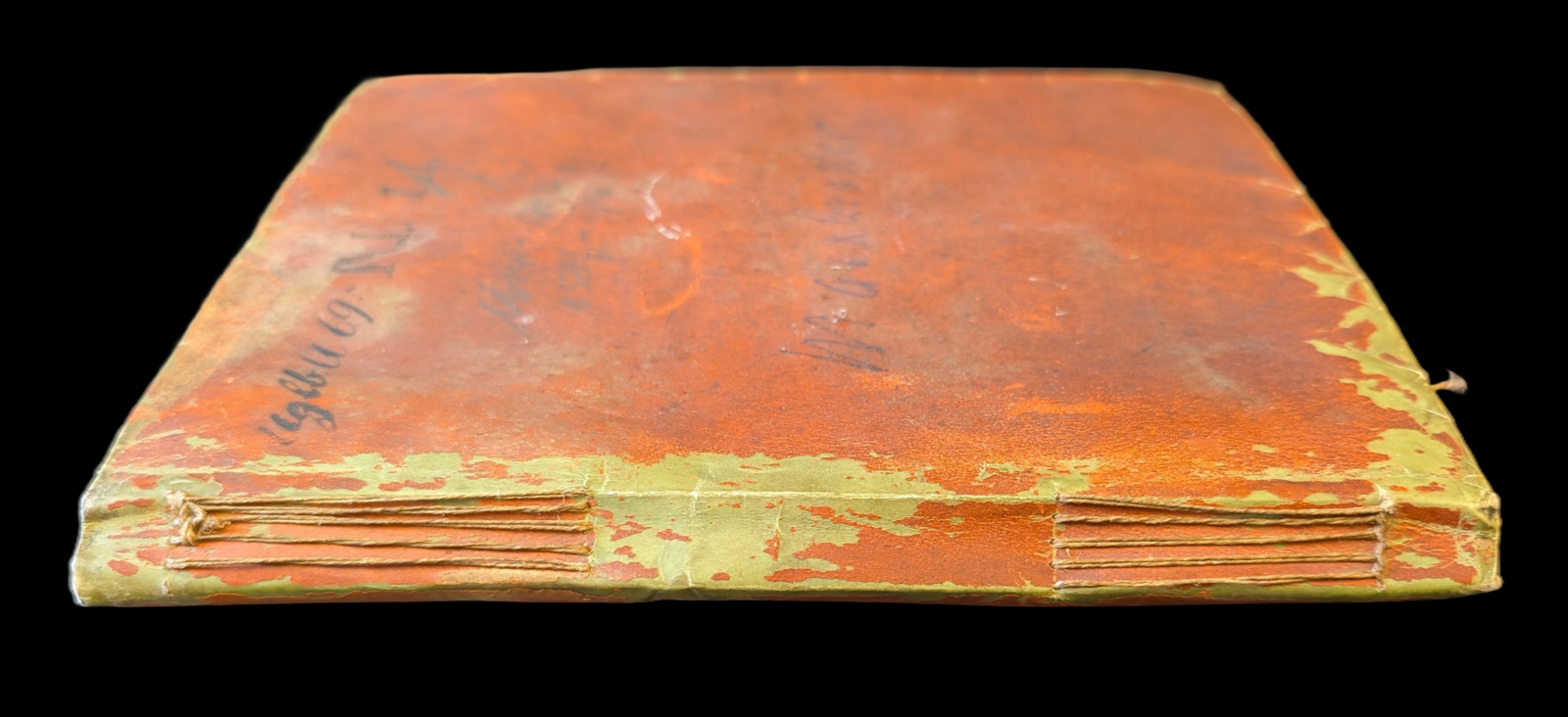
The volume is bound in a reddish–orange cover (hence the name), measures 15 × 21 × 1.7 cm, and weighs about 300 g. In addition to 36 written folios4 (72 pages), it includes 39 blank folios at the end. Notably, the entries end in 1716 although the manuscript provides considerable unused space, suggesting that the brotherhood’s orderly administrative activity came to an end in that year.5
The book records all masters and captains of the Marxbrüder from 1583 to 1716 and is written in several hands using the typical cursive of early modern German manuscripts. My full transcription of this source is archived on Zenodo.
In total, the book lists 254 masters and captains (roughly two per year), along with their occupation, hometown, and – where applicable – citizenship. Extracting these, together with the 109 masters and captains recorded in Cod.I.6.2º.5, yields a corpus of 363 Marxbrüder.6 An Excel file with Readme is included in the Appendix.
Mapping Occupations: What jobs did the Marxbrüder have?
To understand the social profile of the Marxbrüder, I extracted occupational information for all masters for whom such data is available. This yields 284 individuals between 1530 and 1680 – the longest continuous period covered by the sources. For clarity, I aggregated occupations into seven broad categories and grouped the data by decade.
The resulting stacked area plot shows, for each decade, how many newly admitted masters of the sword belonged to each occupational group.
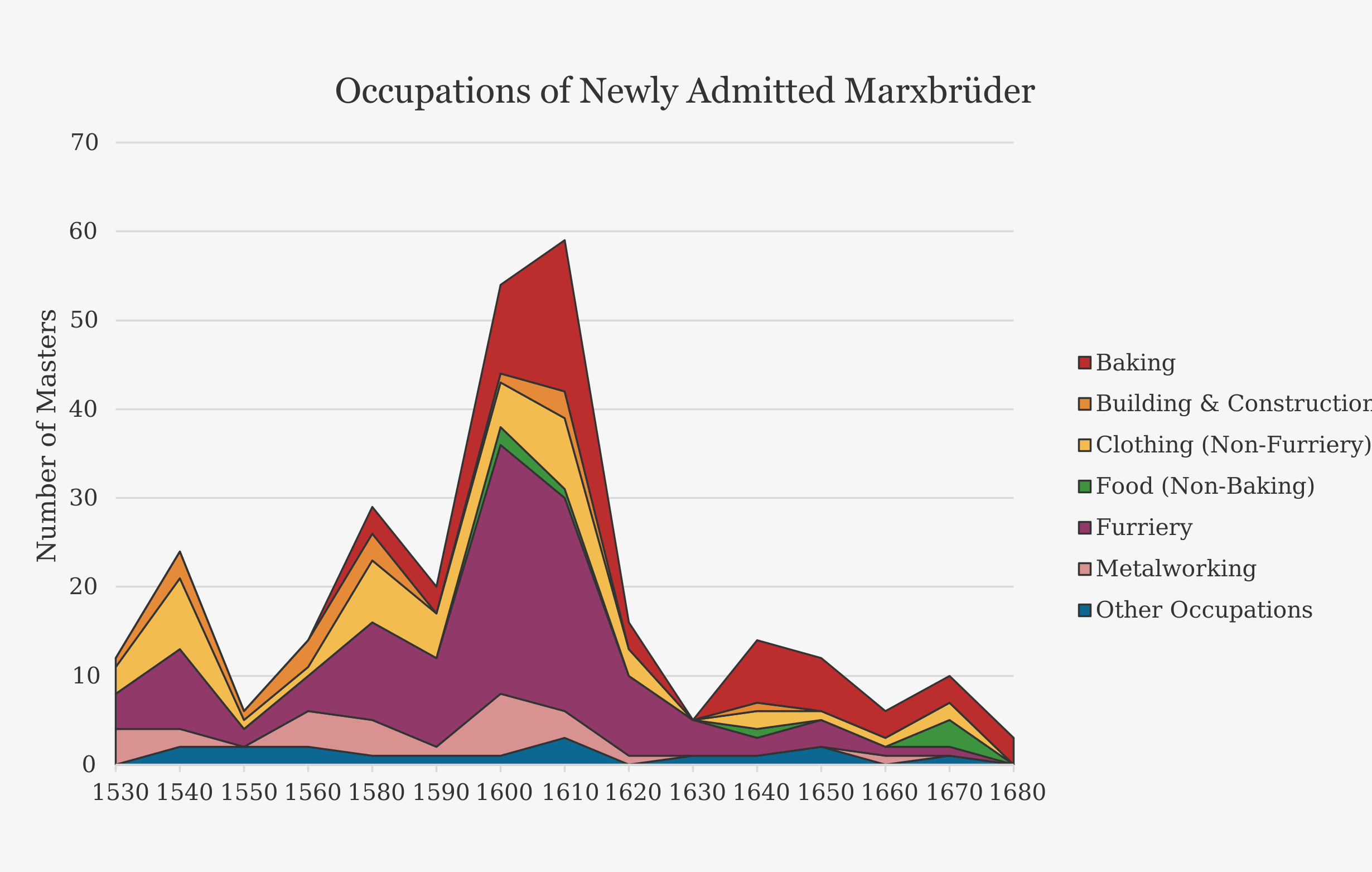
Across the entire period, furriers dominate by a wide margin, followed by bakers (including confectioners and gingerbread makers) and textile workers. Metalworkers, food‑related trades, and building professions appear in smaller but steady numbers, while a long tail of rare occupations forms the “Other” category.
Before turning to the broader implications, it is worth recalling how earlier scholarship characterized the Marxbrüder’s occupational profile. The 1894 Fechtbüchlein – a popular‑scientific work on German fencing brotherhoods – offered a strikingly specific list of “typical” Marxbrüder and Federfechter trades:7
- Marxbrüder: bakers, furriers, file cutters, hammer smiths, passamenterie makers, red‑metal casters, bell makers, saw smiths, potters, and cloth makers;
- Federfechter: wire drawers, wood turners, dyers, fire‑wall masons, goldsmiths, girdlers, tinsmiths, knife smiths, needle‑makers, locksmiths, and pewter casters.
Both groups allegedly also included princely servants, guardsmen, and hunters. If this sounds suspiciously precise, you are not alone. The authors cite no sources, and none have been identified since. That said, early modern craft specialization was indeed remarkably granular, with niche trades – such as “Nestler,” specialized producers of leather laces – flourishing in urban centers. With the complete dataset now available, we can finally test these assertions. As it turns out, the broad tendencies (furriers, bakers, clothmakers) are indeed correct, while the more granular claims do not hold up.
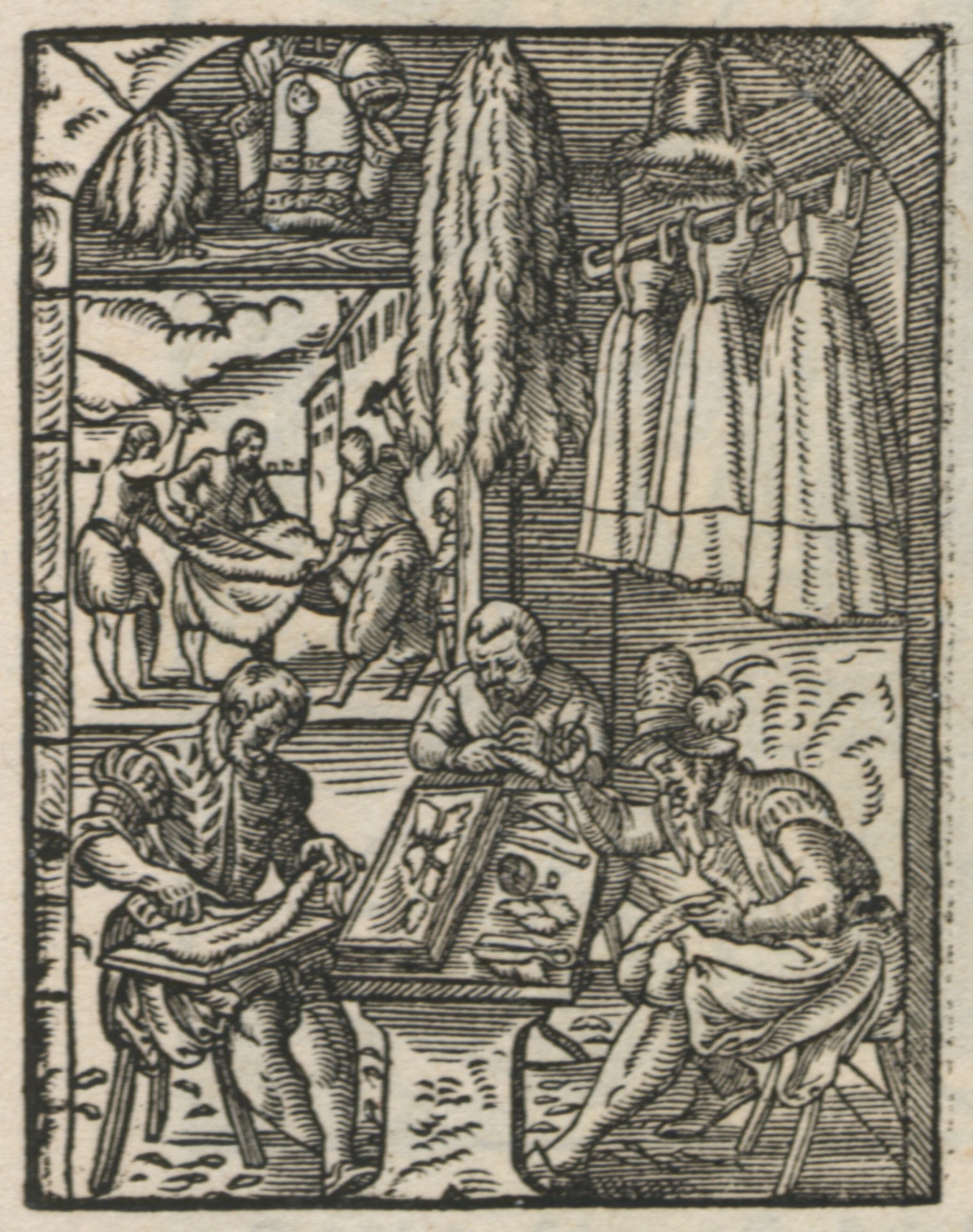
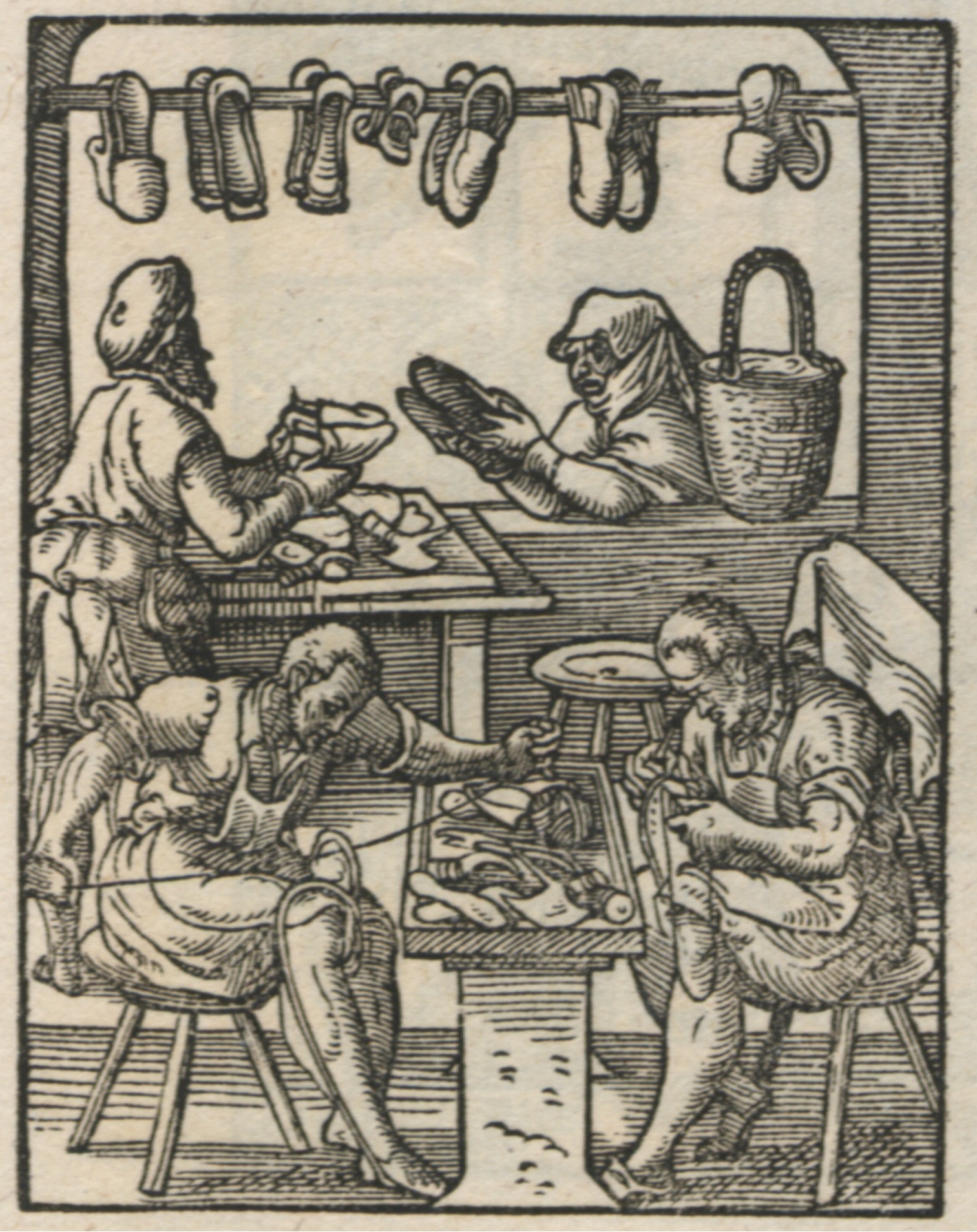
To give a sense of the socio‑economic world behind these categories, it is helpful to look briefly at contemporary depictions of the dominant trades:
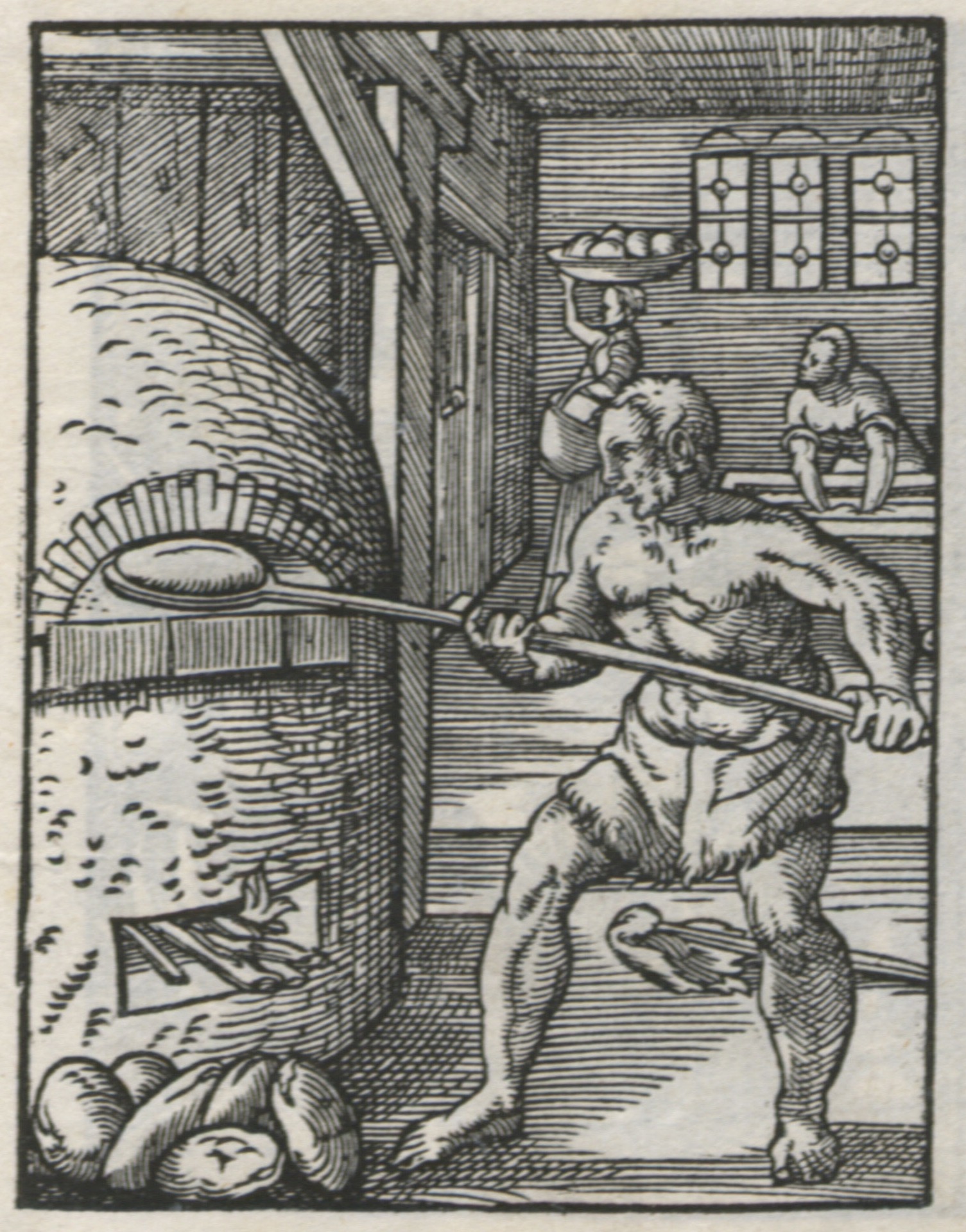
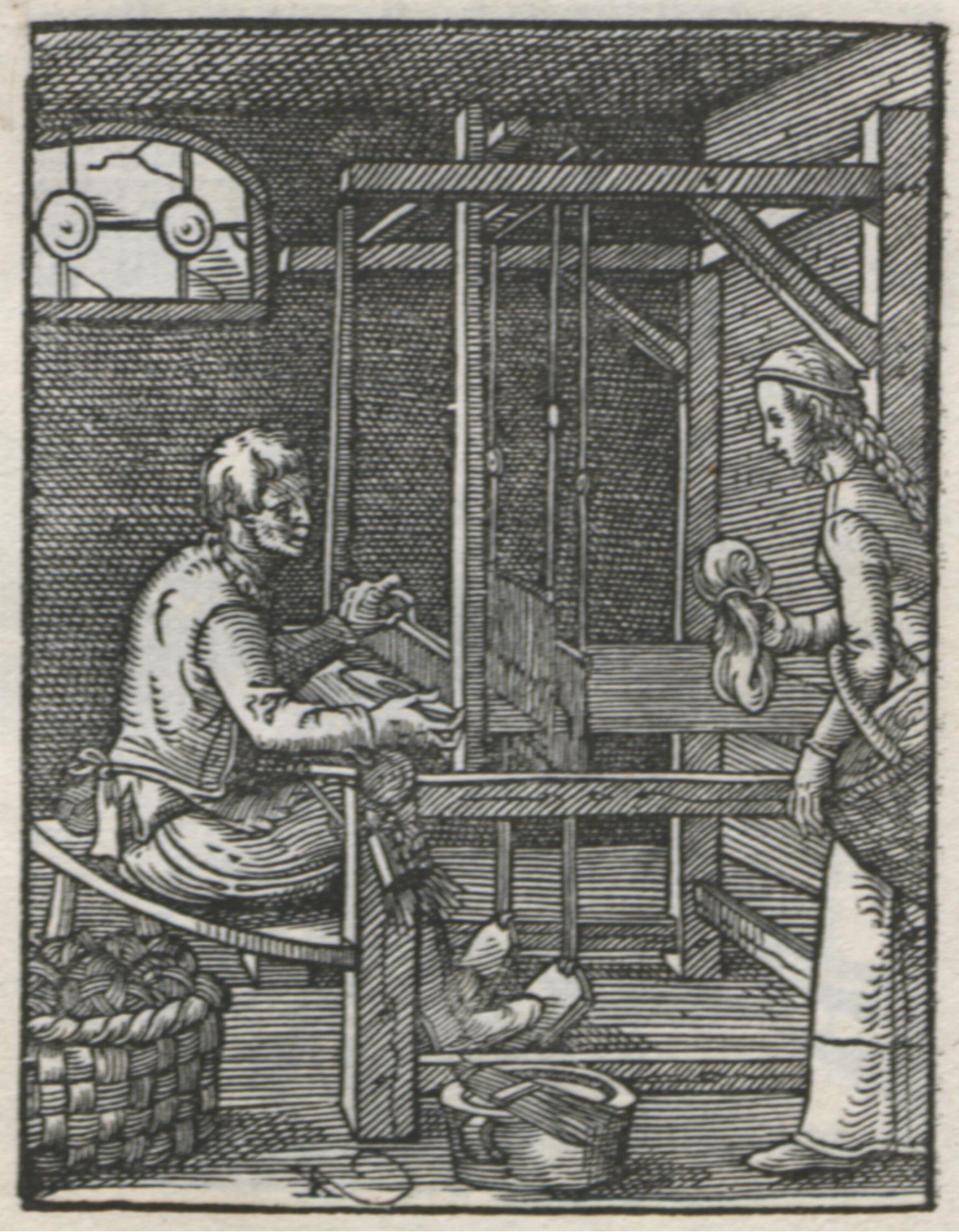
These results also echo the broader tendencies noted by Sabine Kindel,11 even if the absolute figures diverge in certain details. Her work established the foundations of the occupational distribution; working from a complete transcription here refines those figures while still confirming the same overarching tendencies: furriers predominate, followed by bakers and textile workers.
Turning back to the plot, the pronounced spike around 1610 reveals another interesting finding: the Marxbrüder appear to have reached their numerical peak in the early seventeenth century, with around sixty new masters in that decade. Thereafter, the numbers decline sharply, dropping to fewer than twenty in the following decade – a decrease of roughly two thirds. This coincides with the first imperial privilege granted to the competing Federfechter in 1607. My working hypothesis is that the rival fencers attracted many who otherwise would have joined the former monopolists, the Marxbrüder.
It would therefore be illuminating to conduct a similar analysis for the Federfechter (if comparable chronicles survive, perhaps in Prague) and overlay both plots. If the hypothesis holds, the Federfechter curve should mirror the Marxbrüder’s: relatively low numbers before 1610, followed by a rapid rise thereafter.
To summarize: How correct was the Fechtbüchlein regarding predominant Marxbrüder crafts? Considering the lack of sources available to its authors, surprisingly so. They correctly identified furriers, bakers, and clothmakers as major groups. The rest of their list, however, is too granular to be meaningful and finds no support in the primary evidence.
Mapping Places: Where did the Marxbrüder come from?
Besides occupations, the data also reveals the geographic heritage of the Marxbrüder. It is conventional wisdom that most of these fencers came from what is now southern and central Germany, but we’ll see in a bit that there are many more remarkable (and perhaps surprising) geographic centers. In conjunction with the prior analysis, we can also observe interesting shifts over the centuries.12
Restricting the sample to just those masters with available origin (hometown or citizenship) information yields 318 individuals. Ranking top-places of origins with at least five masters yields the following distribution:
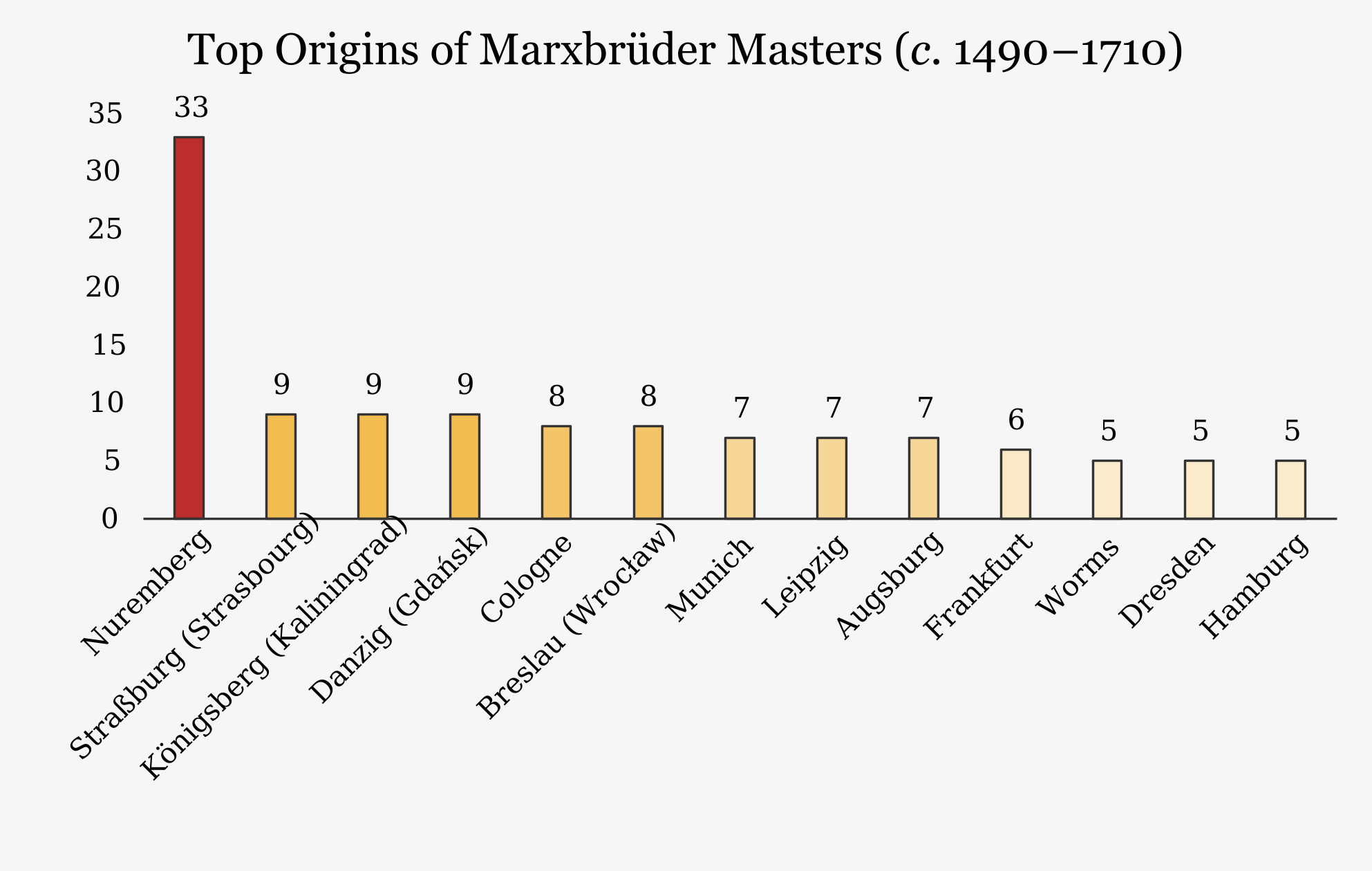
Nuremberg dominated by far (33 masters or about 10%), followed with some distance by Straßburg, Königsberg, and Danzig, each with 9 masters.
To get a better spatial feel of Marxbrüder spread across central Europe, I used Python to create four interactive maps along the four semicenturies in the sample (1500–1549 up to 1650–1699). The resulting interactive maps are shown below. Of course, overlaying modern borders onto early modern mobility is anachronistic, but it helps visualize the general geographic spread.
You can move around the map freely using touch or mouse, and hover over the colorful circles to see how many masters came from each place – revealing the exact count and the town name as it appears in the source (and today’s local-language names in brackets for orientation). Zooming in and out is also possible whenever you want a closer look.
1500–1549: Origins of Marxbrüder Masters
1550–1599: Origins of Marxbrüder Masters
1600–1649: Origins of Marxbrüder Masters
1650–1699: Origins of Marxbrüder Masters
Coinciding with the occupational analysis, we observe an increase in geographic spread up to the period 1600–1649, and a sharp decline afterwards. So, perhaps not surprisingly, the growth in numbers was also accompanied by a larger distribution throughout central Europe.
While Nuremberg, the massive yellow circle, is again dominating by far, other notable centers include: the Rhine–Main region, Upper Bavaria, Saxony, Prussia, Silesia, and Bohemia.
The total area covered extends from Hamburg in the north down to Villach in Carinthia (Austria) in the south, and from Saint Vith (Belgium) in the west across to Riga in the east. Therefore, while southern Germany was a dominant Marxbrüder center, the data exhibits far more variance and spread across locations than at least I had initially assumed.
It would be fruitful to view this distribution not only geographically, but also through the lens of confessional boundaries and the competing networks of Marxbrüder and Federfechter that shaped these regional clusters.
Selected Figures and Fechtschule Episodes
Before turning to the spatial dimension of Marxbrüder activity in Frankfurt, it is worth highlighting several qualitative insights from the Red Record Book. These individual cases illuminate the lived realities behind the dataset and offer a glimpse into the personalities, events, and occasional drama that shaped the brotherhood’s history.
- Melchior Gaißmann, a Nuremberg locksmith13 whose beautiful epitaph featuring the Marxbrüder arms can still be visited,14 acts as captain of the brotherhood in 1583.15
- From 1586 to 1593, masters of the sword were publicly appointed in the Krachbein, an inn in Frankfurt16 – a location we’ll discuss in more depth toward the end of the article.
- An exception to this is Georg Faul of Nördlingen: In 1587, at 21 years of age, he was made master in the Schelmengarten,17 a site likely associated with dishonorable burials behind the Dominican monastery.18 Beyond baking and fencing, Faul also appears to have been a brewer who introduced brown beer to Nördlingen from Nuremberg.19 His epitaph, created in 1621, was still recorded in St. George’s Church in the early twentieth century,20 though it remains uncertain whether it survived the destruction of the Second World War and the organ fire of 1971.
👉 If you happen to be in or near Nördlingen: I would be genuinely grateful if you could check whether Georg Faul’s epitaph is still in St George’s. - Paulus Reuter, a Nuremberg carpenter made master 1589,21 is very likely the same person that accidentally killed a goldsmith journeyman during a Fechtschule in Frankfurt in that same year.22 One year later, in 1590, he was again involved in a fatal incident: during a Fechtschule in Nuremberg, he unintentionally killed the dyer Hermann Mayer. As a consequence, he was imprisoned and subsequently banned from both fencing and visiting inns within the city.23
- Klaus Rindfleisch, captain of the brotherhood from 1596 to his death in 1602,24 was something of a local celebrity – at least, he prominently appears in Mangold’s Marckschiff, a 1596 song about the Frankfurt trade fair.25 This overlapping source is interesting because it not only features a period account of a Marxbrüder Fechtschule – heralded by drums and pipes – but also confirms several masters in the dataset: There is a tall “von Cöln” among the leaders, likely referring to 1594 captain Christian Gülich von Köln. Moreover, an old white-haired fencer with a patched-up head called “der Altreiss” could be Konrad Friedwach, who became master in 1584 and made masters in the captain’s stead 1589–1591.26
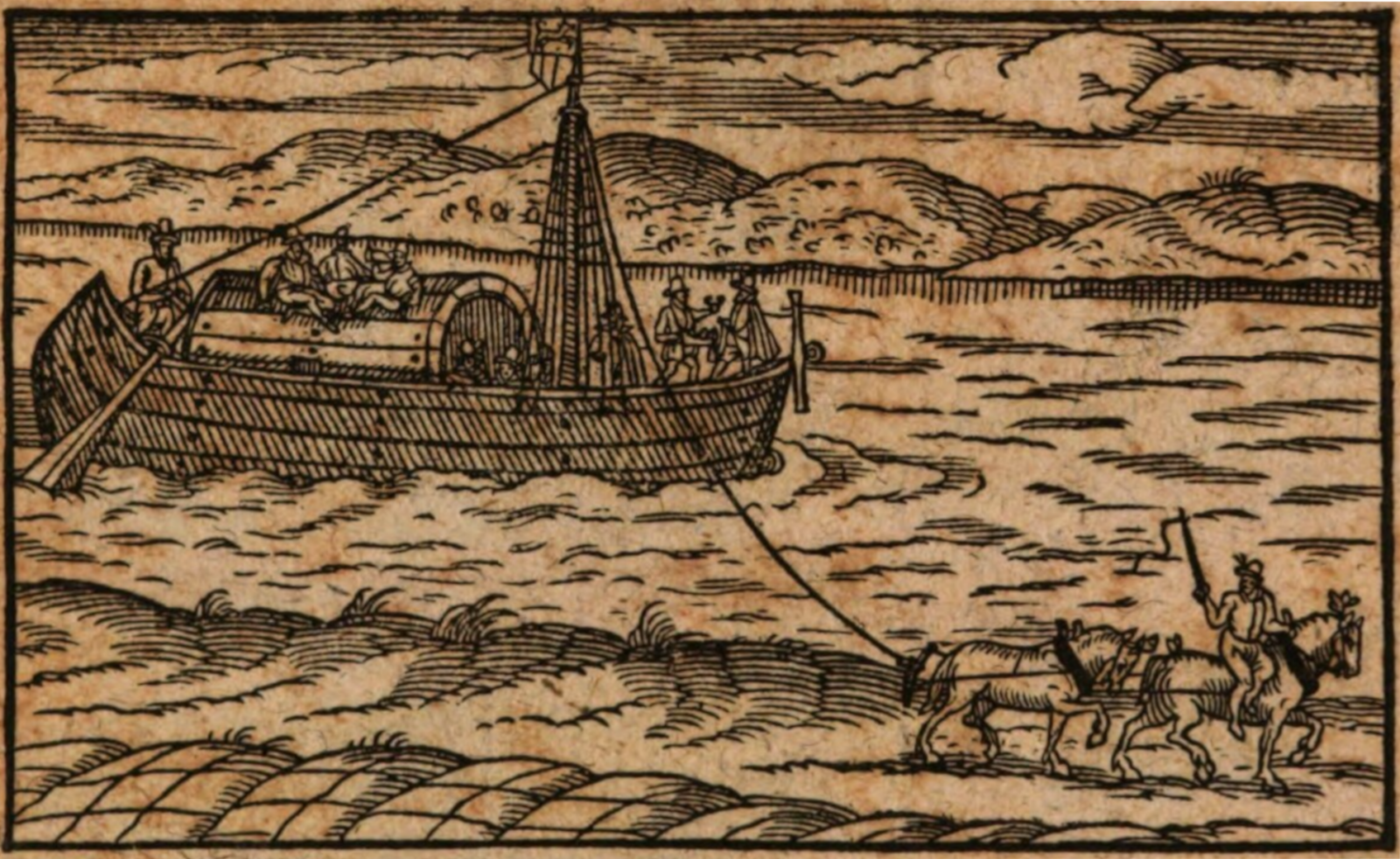
- The cover of the Marckschiff features a horse-drawn barge – the eponymous “market ship” used by trade fair visitors from Mainz. From the dataset, we can assume Ludwig Stoll (1532), Sigmund Mair (1539), furrier Jerg von Erdingen (1548), and blacksmith Sigmund Schamberger (1548) likely took this route.
- I found another epitaph for Konrad Wischeckel, a furrier from Nuremberg that acted as proxy from 1603 to 1606.29 This one is located on St. John’s Cemetery in Nuremberg, tomb number 855.30
- In 1612, two Trabanten (i.e., bodyguards) become masters at the election day of Emperor Matthias.31 This is not only significant because of the occasion, but also as – to my knowledge – the only other known Trabant joining the brotherhood was Onofrius Sokh.32
- In 1613, the furrier Bartholomäus Eckhart from Breslau fails his first attempt for the master examination because he struck “bloodthirstily” and the Federfechter didn’t want to let him pass.33
- The famous German fencing master Wilhelm Kreußler, who is often cited to have become a master of the sword in 1618 is not contained in the records (neither in that nor any other year), adding further evidence that his supposed mastership is likely apocryphal.34
Interestingly, not a single master is made in that year – perhaps due to the onset of the Thirty Years’ War. This mirrors the documentary gap during the Frankfurt guild uprising some 100 years earlier. Although Frankfurt itself was not a battleground and the trade fair apparently took place,35 the political climate was intense, and it is likely that the council did not approve a large public gathering of armed men.36 - The following year, the baker Hans Rambisch from Bamberg was wounded during the examination and therefore not admitted; he successfully repeated it on 20 September 1614.37
- Furrier Michael Lembke from Preußisch Holland (Pasłęk) becomes a master in 1625, and captain the next year.38 Several master’s certificates issued by Lembke are stored at ISG Frankfurt.39
- In 1666, Martin Kähl – familiar to us from this article – becomes master and later captain.40 He too left us several documents in Frankfurt.41
- Three years later, Georg Zwickel from Nuremberg becomes master. Just like Kähl, a copper engraving with his portrait features the augmented Marxbrüder coat of arms.42
- In 1671, Gottfried Glatz, a “studiosus” from Breslau (Wrocław) enters the Marxbrüder ranks.43 This is remarkable because this is the only documented student joining the brotherhood.
Part II – Mapping Social Space: Marxbrüder Sites of Memory Continued 🗺️
This section concludes the mini-series on Marxbrüder meeting spots in Frankfurt that I began with “Religion and Revolution” in December 2025.
While the first half of this study reconstructs the Marxbrüder through numbers – occupations, hometowns, and long‑term demographic patterns – the second half turns to the physical and symbolic spaces in which these fencers moved.
Social space is never abstract: it is anchored in streets, inns, and the urban memory of a city. Having mapped who the Marxbrüder were and where they came from, we can now return to Frankfurt and examine the places where they appeared, gathered, and were remembered. As we will see, these sites of memory are as revealing as the dataset itself – especially since several long-standing assumptions about them, above all the notion that they maintained some kind of guild hall, prove to rest on surprisingly shaky ground.
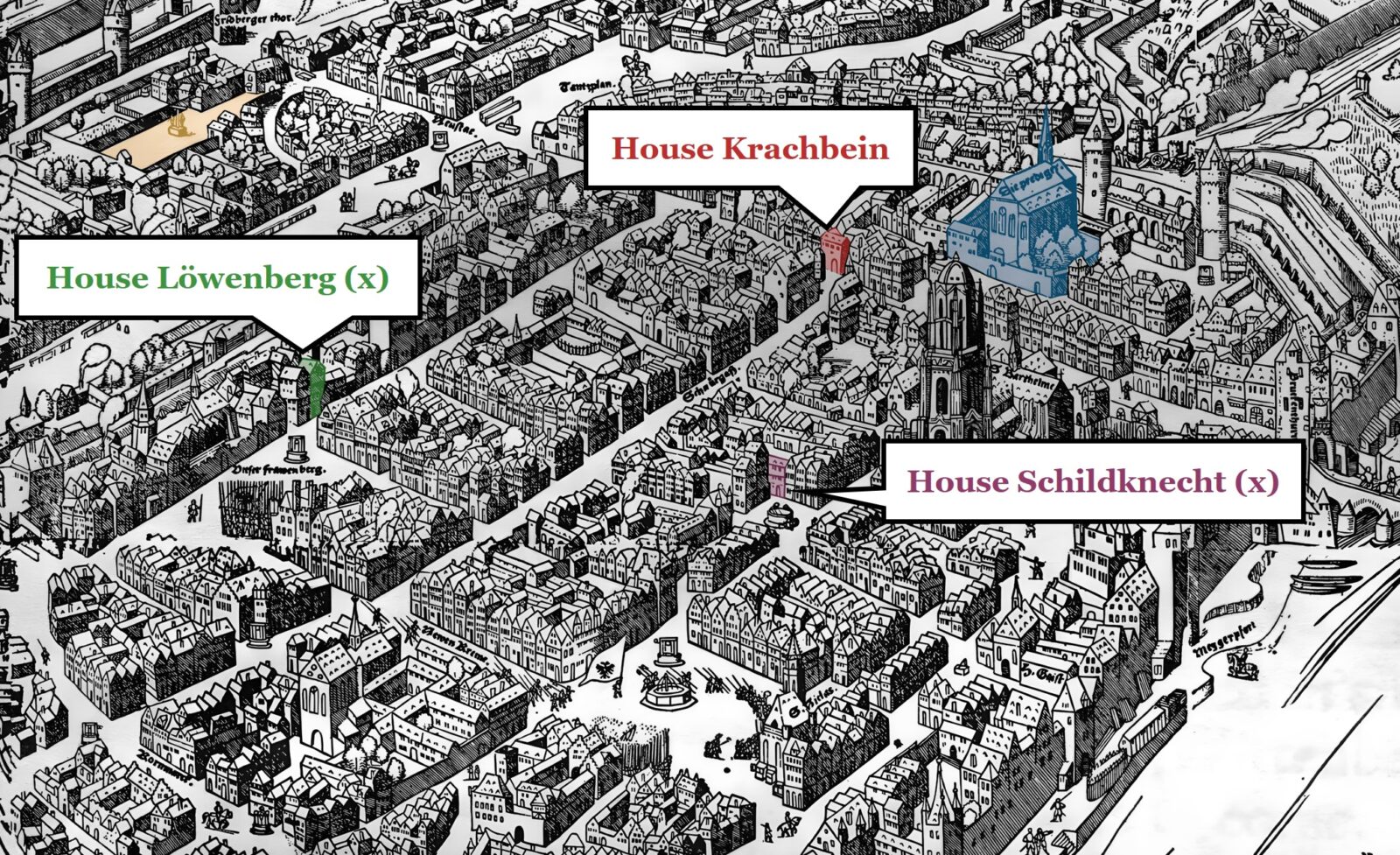
House Schildknecht alias House St. Marcus
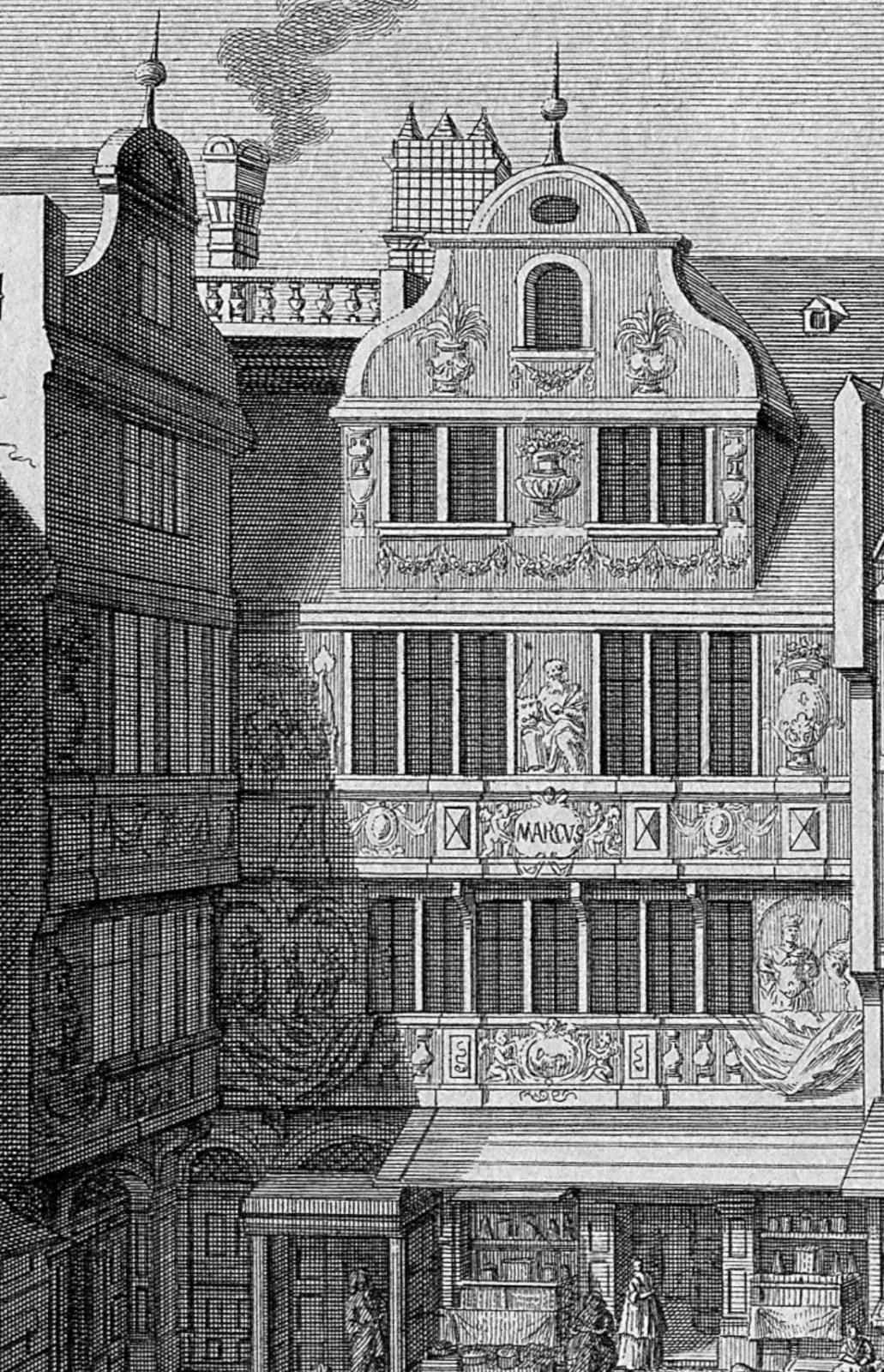
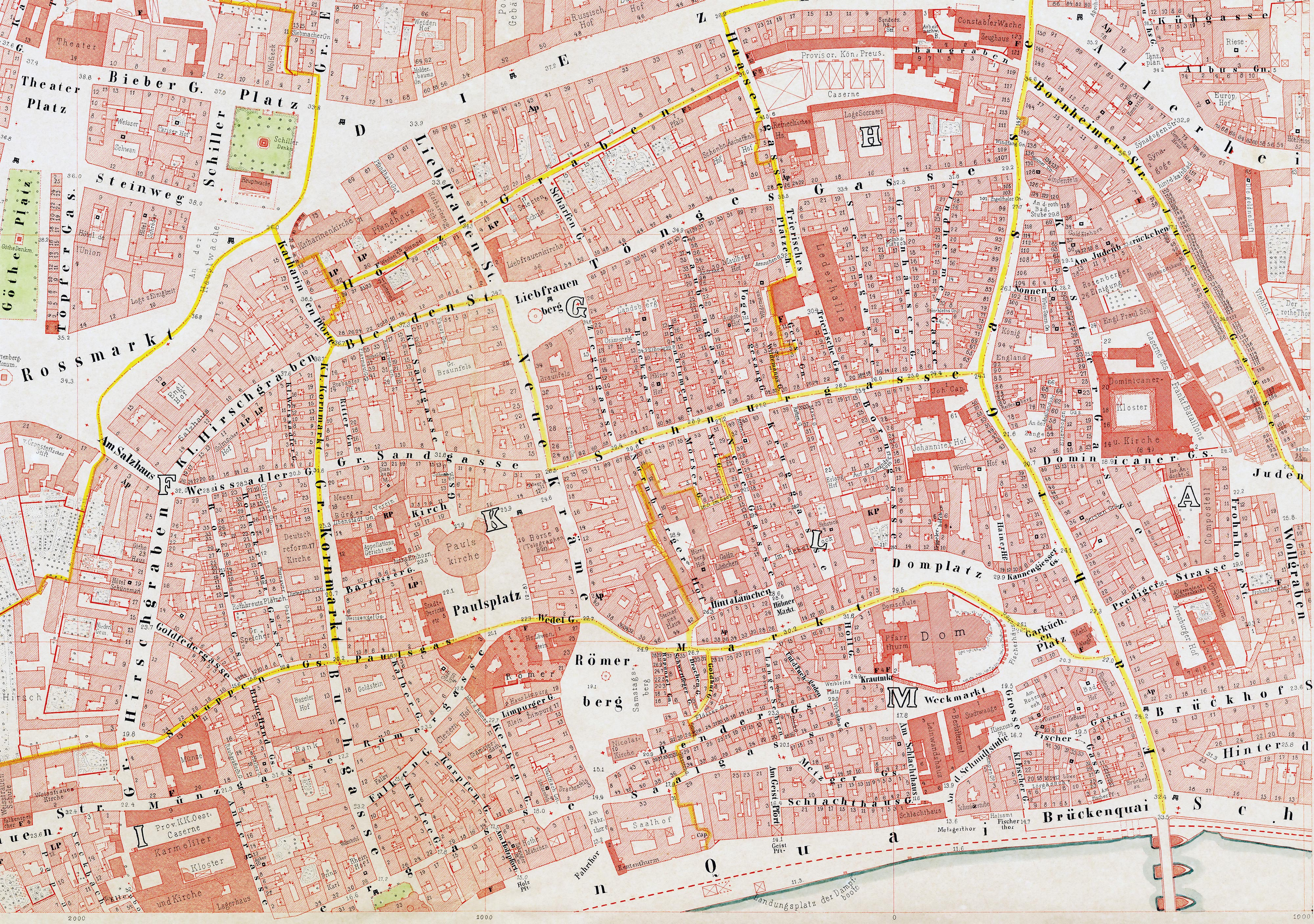
House Schildknecht – later known as House St. Marcus – was the shoemakers’ guild house at Hühnermarkt 18 (Lit. L. 148). Its association with the Marxbrüder appears in 19th‑century literature, most notably in Heinrich Koch’s reading of the previously discussed 1458 passage in Jacquin’s Chronicon referring to “the fencing masters [original: schirmeyster] who are in St. Mark’s brotherhood.”45 Koch erroneously equated the “schirmeyster” with shoemakers and therefore also placed them in their guild hall. Apart from a confusion of these terms,46 the argument rests entirely on the shared dedication to St. Mark.
Even if we ignored the clear interrelationship between the Chronicon and the Medel Fechtbuch (cf. my previous article for a close reading), this identification cannot be sustained. First, the building did not bear the name House St. Marcus during the Marxbrüder’s active period, especially not in 1458. In the late 18th century, Johann Georg Battonn explicitly notes that the house assumed the name St. Marcus only “in recent times,” and that he himself had seen the life‑sized depiction of the saint with his name in golden letters on the façade.47 This places the renaming well after the active period of the Marxbrüder (see also Part I of this article), making it chronologically impossible48 for the Marxbrüder to have known or used the building under that name.
Second, the occupational profile of the Marxbrüder does not support a connection to the shoemakers’ guild. Only five masters in the entire dataset were shoemakers, and none of them were Frankfurt citizens.51 The overwhelming majority were furriers, bakers, and textile workers – perhaps adjacent to shoemaking in the broader leather and cloth economy, but not institutionally linked to the shoemakers’ guild. Nothing in the Marxbrüder’s own records suggests that they ever used a craft guild hall as a meeting place.
Third, the Marxbrüder’s documented activities point in a different direction entirely. Their Red Record Book repeatedly places master appointments and Fechtschulen in public venues – most prominently the Krachbein – rather than in guild houses. The brotherhood functioned as a mobile, event‑based association, not as a craft guild with a fixed hall.
In light of this, the identification of House St. Marcus as a Marxbrüder meeting place is best understood as an onomastic misunderstanding: an 18th‑century attempt to harmonize two institutions dedicated to the same saint, despite the absence of any primary evidence linking them. While the shoemakers’ guild records do contain occasional references to armed altercations among journeymen,53 these incidents reflect tensions of early modern martial culture, rather than any connection to the Marxbrüder.
House Schildknecht was destroyed in 1944 and reconstructed between 2012 and 2018 as part of the New Frankfurt Old Town project. Its modern façade at Markt 18 preserves the memory of the site, but not of any historical association with the Marxbrüder.
Although the Marxbrüder most definitely did not meet at this place, I note in passing that a thorough analysis of ISG Frankfurt’s holdings on House Schildknecht could still be an interesting – if mostly unrelated – research endeavor.54
House Löwenberg
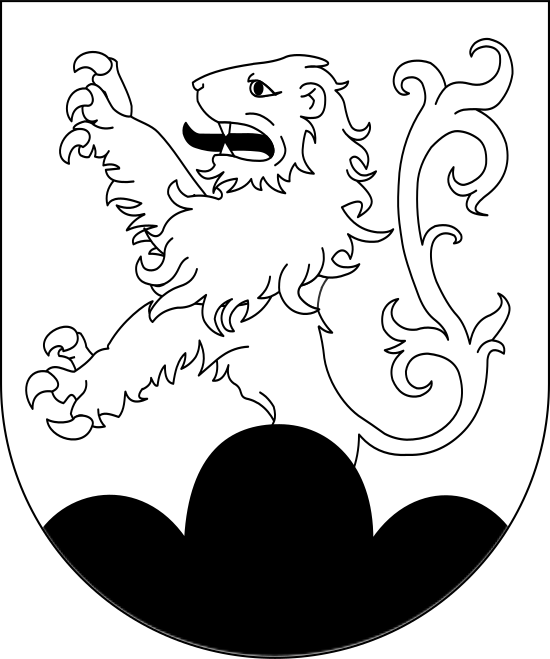
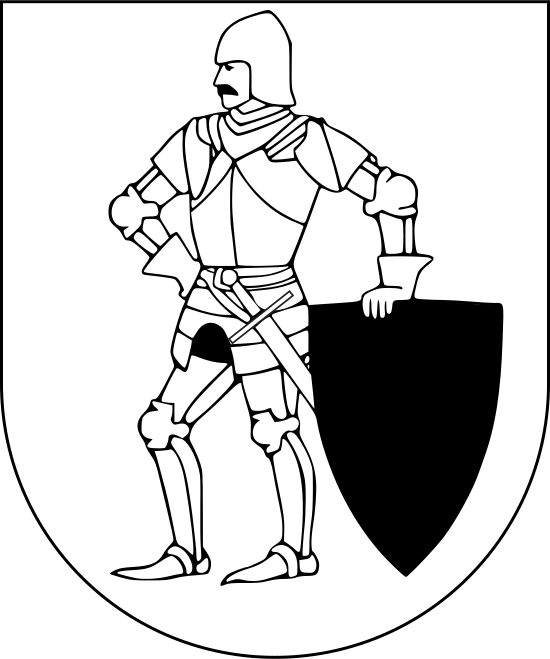
Following their armorial augmentation by Emperor Leopold I in 1670, the Marxbrüder styled themselves opulently as “Masters of the Long Sword and Experienced Practitioners of the Military Exercises of St. Marco and Löwenberg.”56 Karl Wassmannsdorff interpreted the new epithet “Löwenberg” as a heraldic-symbolic reference to the lion standing on a trimount.57 Other 19th‑century authors, however, attempted to anchor the term in Frankfurt’s topography by identifying a House Löwenberg as a supposed meeting place of the brotherhood.
This identification rests on shaky ground. The claim originates in commented editions of Peterweil’s Beschreibung der Reichsstadt Frankfurt58 and Battonn’s Lokalbeschreibung,59 which both mention House Löwenberg at Töngesgasse 46 (Lit. G 24) as a Marxbrüder gathering spot. Yet the evidence provided does not withstand scrutiny.
The first cites pp. 23 onward of Florian’s 1664 Chronica, which contains only a general reference to the Marxbrüder60 and says nothing about a house named “Löwenberg” – i.e., this is a classic example of a misquotation. The second offers no source at all. In other words, the entire tradition appears to originate in 19th‑century antiquarian inference rather than in primary evidence.
Complicating matters further, Frankfurt had two houses named Löwenberg, neither of which aligns with Marxbrüder activity.
The first, at Töngesgasse 46, was a substantial patrician residence. Its documented owners include jurors,61 French-reformed merchants,62 and later members of the Lombard noble house Brentano‑Gnosso.63 Nothing in its function or ownership suggests a connection to fencing masters or with the venues in which the Marxbrüder are known to have operated.
The second, at Krautmarkt 6 (Lit. M 203), served from 1311 to 1610 as the tanners’ guildhall64 and also appears in primary sources as the “Lederhaus.”65 Löwenberg could derive from Löwer, a historic term for tanner, rather than through reference to a lion.66 As a guild property, it belonged to the leatherworkers, and surviving records from both the tanners and the Marxbrüder show no overlap or indication of shared use.
Both houses were destroyed in the 1944 air raids. The post‑war building at Töngesgasse 46 occupies the same plot as its predecessor, as confirmed by the Ravenstein Plan of 1861,67 while the former tanners’ hall including the entire topography of Krautmarkt survives only in archival references and antiquarian notes.68
Taken together, the evidence points in a clear direction: The association of the Marxbrüder with House Löwenberg is a 19th‑century construct, created by conflating the heraldic-symbolic “Löwenberg” of the 1670 augmentation with an unrelated Frankfurt building that happened to share the name. No source – neither in the secondary literature, nor in the Medel Fechtbuch, the Red Record Book, or any guild or property records – supports such a connection. In light of this complete absence of evidence and the mismatch with the Marxbrüder’s documented practices, there is no historical basis for linking the brotherhood to a House Löwenberg.
House Krachbein69
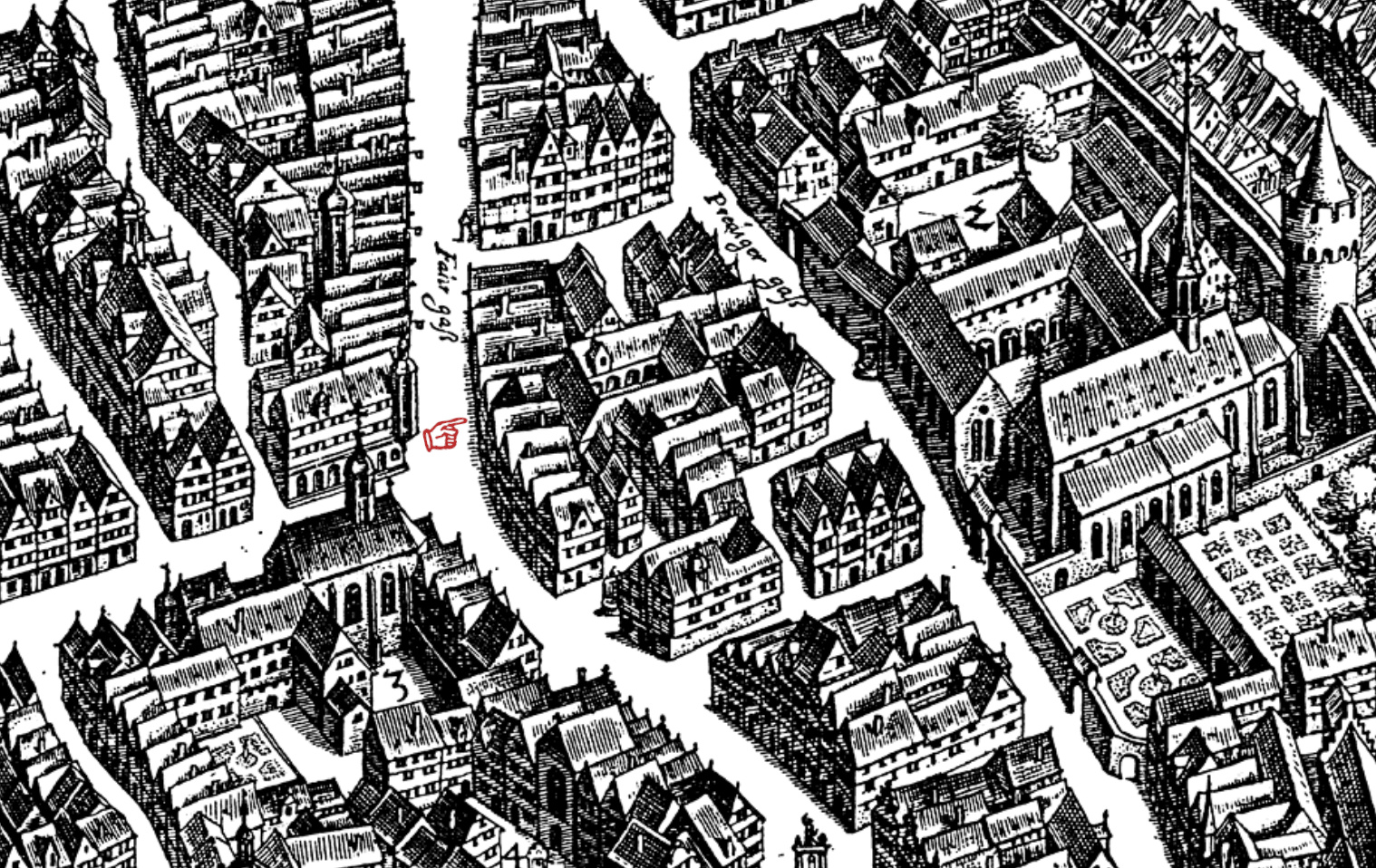
After this unsatisfactory interim conclusion – two of three previously claimed meeting places remain unsubstantiated – let us turn to a location at which the Marxbrüder definitely met, and a rather remarkable one at that. The Krachbein (Lit. A. No. 123)71 was an old, well-known inn to the northeast of Frankfurt, close to the Dominican Monastery.72 During the trade fairs, it accommodated large numbers of visitors, and it was here that the Marxbrüder publicly created their masters of the sword. The Red Record Book mentions this repeatedly in the late 16th century.73
A 17th century poetic description of the trade fairs likewise refers in passing to a Fechtschule at the Krachbein, followed by a comedic theatre.74 By that that time, the inn was not a mere drinking house but a large, lively entertainment venue. It possessed a spacious dance hall75 with a substantial stage (attested already around the Thirty Years’ War 1628–1648) which regularly hosted English comedy troops76 and dance events. Such a setting was ideal for Fechtschulen, which required ample room for numerous fencers wielding weapons such as long swords and polearms as well as space for musicians, and an assembled audience. As with performances at the Globe Theater, specators likely would have eaten and drunk – perhaps Bamberg beer mentioned in this context,77 or Rhenish wine.

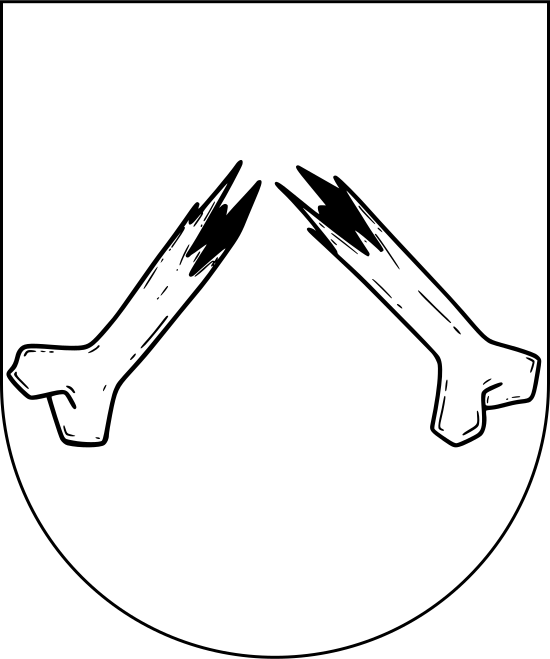
In keeping with the establishment’s spirited character, its hanging sign humoristically played on the name Krachbein (“crack-bone”) by showing two angels breaking a bone in two.80

Making a Master of the Sword
Unfortunately, the sources do not describe the ceremonies at the Krachbein in detail. Thankfully, the Frankfurt Fencing Regulations provide a clear account of the master-making process from 1534 onward.81 Whether the rules still applied in precisely the same form some forty years later – when masters were made at the Krachbein – cannot be stated with certainty. Later regulations survive, but they do not describe the process of making masters.82 Furthermore, the Red Record Book merely notes that candidates were “publicly dubbed master” at the Krachbein,83 a phrase that refers specifically to the act of admission and not necessarily the preceding fencing bouts. Still, since Fechtschulen are attested at the inn, it is plausible that both the public trials and the formal presentation took place there.
According to the regulations, any sworn master first had to pass a private examination before the captain and two or three appointed masters. They tested his knowledge of the “five hidden strikes”84 performed three times with the weapons long sword, dussack, and staff. Furthermore, the applicant had to demonstrate the “six master‑cuts”85 with the long sword, and a series of dagger techniques. Only if he showed full command of all these elements was he permitted to advance to the public trial.
The public examination consisted of formally presenting the candidate and requiring him to fence multiple bouts with every master present, “on free ground and in free art,”86 without refusing any challenger. If he withstood these encounters without being overcome and was judged by the masters and the captain to have shown sufficient skill, he was admitted to the next ritual.
During the act of admission, the new master kneeled and placed two golden shillings upon a sword, received the symbolic strike from the captain, and swore the prescribed oaths. Afterward, he made the additional payment of one shilling87 and swore the oath of secrecy by God.
The final step, conducted once more in private, consisted of the captain and a small group of experienced masters imparting the confidential knowledge reserved for members of the rank. Only then was the newcomer admitted to the rights and obligations of his rank, including participation in the distribution of fees.
While much more could be said, I’ll pause here for a résumé.
Conclusion: the Marxbrüder, Mapped
Taken together, the transcription of the Red Record Book and the resulting dataset allow us to see the Marxbrüder with a clarity that has not been possible before. Quantitative patterns that were previously assumed – or asserted with great confidence in 19th‑century literature – can now be tested against a comprehensive body of evidence. The results are both confirming and corrective: furriers, bakers, and textile workers indeed formed the backbone of the brotherhood, while the geographic distribution of masters reveals a network far more expansive than the traditional focus on southern Germany suggests. The Marxbrüder were not a narrow craft confraternity but a mobile, pan‑regional association whose members came from Nuremberg to Königsberg, from Strasbourg to Riga.
Equally revealing is what the data does not support. Several long‑standing assumptions about the social and spatial life of the Marxbrüder – particularly their supposed association with specific Frankfurt guild houses – turn out to rest on little more than 19th‑century name‑matching. Neither House St. Marcus nor either of the two Houses Löwenberg can be meaningfully connected to the brotherhood. The Marxbrüder did not operate like a craft guild with a fixed hall; their social space was defined instead by public venues such as the Krachbein, where masters were appointed and Fechtschulen held. Correcting these misconceptions not only sharpens our understanding of the brotherhood itself but also helps disentangle the Marxbrüder from the historiographical projections of later centuries.
This study also opens several promising avenues for future research. A comparable dataset for the Federfechter – if their records in Prague or elsewhere can be located – would allow us to test the hypothesis that the rise of the Federfechter after 1607 directly contributed to the Marxbrüder’s numerical decline. Likewise, integrating confessional boundaries, trade networks, and municipal politics into the spatial analysis could illuminate why certain regions became Marxbrüder strongholds while others remained peripheral. Finally, the gaps in the record during moments of political tension, such as 1618,88 invite a closer look at Frankfurt’s council minutes to understand how urban governance shaped the public practice of fencing.
For now, the picture that emerges is one of a brotherhood deeply embedded in the economic, geographic, and social fabric of early modern central Europe – more diverse, widespread, and dynamic than earlier scholarship assumed. By grounding the Marxbrüder in data rather than conjecture, we can finally begin to understand them not as a romanticized relic of German fencing lore, but as a living institution shaped by the trades, towns, and tensions of their time.
If you enjoyed this article, please consider a donation to help fund my continued research on the Marxbrüder.
Acknowledgements
I would like to thank Werner Ueberschär for his helpful comments regarding the transcription and the signature.
My gratitude also goes to ISG Frankfurt’s Reading Room team (Lukas Mayeres, Kevin Stumpf, and Georgina Lienhard) for swiftly facilitating access to the Red Record Book, and for accommodating even obscure requests – such as weighing and measuring the volume – with great professionalism.
Appendix
Licensing & Attribution
This article and the Marxbrüder Master Dataset are © Kilian Theil (2026). All transcriptions, datasets, visualizations, and analyses were created by the author.
Except where noted, this work is licensed under Creative Commons CC BY‑NC-SA 4.0. Non‑commercial reuse is permitted with attribution; commercial reuse requires explicit permission.
The thumbnail map is not covered by the CC BY‑SA‑NC 4.0 license. It incorporates public‑domain coats of arms from Siebmacher (1605) and map assets by Laurent Mazenc (used with permission). No reuse or redistribution is allowed without my explicit consent.
Suggested Citation
Theil, Kilian (2026). Mapping the Marxbrüder: A Data‑Driven Study of Occupations, Origins, and Social Space (c. 1500–1700). https://kiliantheil.com/marxbruder/2026/02/11/mapping-the-marxbruder
For the dataset itself, please cite: Theil, Kilian (2026). Marxbrüder Master Dataset, 1491–1716. Zenodo. https://doi.org/10.5281/zenodo.20834816
The Marxbrüder Master Dataset 1491–1716
👉 Download the dataset from Zenodo: doi.org/10.5281/zenodo.20834816. This link always points to the current version; the version notes on Zenodo state which version matches Masters of the Longsword.
The Excel file has three content sheets:
- “Data” with the Marxbrüder corpus
- “Analysis of Occupations,” with a pivot table and plot as discussed above.
- “Analysis of Origins,” again with a pivot table and the plot discussed herein.
Structure & Methodology
The key sheet “Data” has 20 columns, each descriptively named. All columns in light green contain data directly extracted from the underlying sources and all columns in light blue contain derived data.
The 109 masters from Cod.I.6.2º.5 were cross-validated with Jens P. Kleinau’s table,89 and the 33 masters originating from Nuremberg with Werner Ueberschär’s table.90
- “Full Name Source” contains all spelling variants contained in the source and is unified into a canonical/typical form “Full Name Standardized.” The same logic applies to “Hometown Source” and “[…] Standardized.” As the latter requires a degree of interpretation, I also add a ternary certainty label from “Low” to “High.”
- There also is contextualizing metadata I added to allow for the analyses presented herein. “Citizenship Source” and “Hometown Standardized” are aggregated into “Origin Aggregated” (use Hometown if available, else Citizenship) and then contextualized with geographic “Origin Latitude” and “Origin Longitude” of that place.
- I classify “Occupation Source” (i.e., the occupation as it is listed in the Marxbrüder chronicles) into seven categories “Occupation Classified” that I devised.
- “Rank” encodes if a Marxbruder became a master (the default case), was elected captain, or made masters in the captain’s stead (which I call “Proxy”).
- “Years” contains the semicolon-separated years in which a Marxbruder is mentioned. I also derive “Year First” (the year of the first mention), “Decade” (the decade that “Year First” belongs to) by assigning all years 149X to decade 1490 and so forth; and “Semicentury” by assigning “Year First” into one of two halves of a century (e.g., 1400–1449 or 1450–1499).
- “Source” and “Source Folio” reference the mentions of that master either in the Medel Fechtbuch, or the Red Record Book (see the transcription). Because the Record Book contains a duplicated folio 35 between fols. 7 and 8, I label this redundant folio as 35* in the dataset to distinguish it from the actual final folio 35.
Transcription of ISG FFM H.18.02, Nr. 13 (Red Record Book)
My full transcription of the Red Record Book is archived on Zenodo: doi.org/10.5281/zenodo.20816085. This link always points to the current version, which supersedes the transcription originally published in this appendix.
Additional Codicological Observations
- The volume is bound using limp binding with five sewing stations.
- The back cover once had a hole that was repaired by gluing a piece of paper over it from the inside.
- The pages show slight waviness, likely caused by moisture exposure.
- Folios 2 and 6 are fretted at the upper right corner.
- Folios 35v and 36r bear a dark stain toward the top, suggesting these leaves lay closest to the cover during storage.
Changelog
- 23 October 2026: Added a reference to Masters of the Longsword. The dataset download now links to its Zenodo record instead of a file on this site; added a dataset citation. Replaced the transcription of the Red Record Book in the appendix with a link to its Zenodo record, which is the current version.
- Which I had the pleasure to attend on 26 May 2025 at ISG Frankfurt. There also is a recording from 27 November 2025, wherein she introduces a foundational sociodemographic study from 18:20 onward. ↩︎
- Maar (1961): “Anfang, Blütezeit und Verfall der Fechtkunst in Nürnberg vom 14. bis zum 19. Jahrhundert.” ↩︎
- Institut für Stadtgeschichte (ISG) Frankfurt: H.18.02 (Marxbrüder und Federfechter: Urkunden und Akten des Rates) Nr. 13. ↩︎
- The folio numbering (added later in pencil) runs 1–7, 35, 8–35. In other words, the number 35 was assigned twice. This duplication may be the result of a later rebinding, as the ISG FFM stamp appears on the recto of the first folio numbered 35, indicating that it once formed the end of the volume. In addition, a folio between 8 and 9 was clearly cut out, and the second folio 35 is blank on its recto, with text only on the verso. ↩︎
- Later inventories (cf. toward the end of my last article), also do not contain a newer record book. ↩︎
- The dataset covers most of the brotherhood’s tenure, except for the less documented early years 1450–1491, and the waning years post 1716, along with a small documentary gap 1566–1583 (between the two chronicles).
↩︎ - Schmied-Kowarzik & Kufahl (1894): Fechtbüchlein, p. 114. ↩︎
- Sachs (1567): Ständebuch. ↩︎
- Sachs (1567): Ständebuch. ↩︎
- Sachs (1567): Ständebuch. ↩︎
- As discussed in her excellent talk on the Marxbrüder, with a recording from 27 November 2025 available online, courtesy of DDHF. The part about Marxbrüder occupations starts at around 18:20. ↩︎
- Sabine Kindel also provided a tabular analysis of several locations in her DDHF talk from about 21:00 onward. ↩︎
- Schwertbund Nürnberg: “Geschichte der Fechtkunst. Nürnberg – ein historisches Zentrum der Europäischen Kampfkunst.” ↩︎
- Ibid. He died seven years after becoming a master, in 1590. His epitaph on St. Rochus Cemetery, Nuremberg is located at 49°26’50.5″N 11°03’37.6″E (cf. Leuchtenstern) and features canting arms: St. Mark’s lion with a long sword in the crest and top field of a divided shield, with a goat in the bottom field (“Gaißmann” literally translates to “goat man”). Around the arms appear locks, alluding to his profession. I am indebted to Werner Ueberschär for making me aware of this epitaph. ↩︎
- H.18.02 Nr. 13, fol. 3r. The record book starts in that same year, so he may already have been master for some time. ↩︎
- H.18.02 Nr. 13, fol. 4v–7r. ↩︎
- H.18.02 Nr. 13, fol. 4v. I inferred his age from his epitaph: he died on 17 November 1621 at 55 years of age. ↩︎
- ISG FFM, H.19.01, 2468 locates it there. This would likely be outside the old town fortifications and south of the Jewish quarter. The garden’s name could also refer to the knightly family Schelm von Bergen. ↩︎
- Beyschlag (1803): “Beyträge zur Nördlingischen Geschlechtstheorie,” vol. 2, p. 101 f. ↩︎
- In 1803, it was listed as number 74 and located beneath the organ. It displayed the familiar Marxbrüder arms: a black shield bearing a winged lion with a sword in his right (here also with a book in his left). A 1914 reference notes that the epitaph included a portrait and had been renumbered to 86. According to Wikimedia photographs, there are indeed epitaphs beneath the side organ today, but the image quality is too poor to determine whether one of them belongs to Faul. He also appears as a sealer in 1608, so it is possible that another Marxbrüder seal survives in the Nördlingen city archives under signature U 7392 dating to 1603 April 4/14 (cf. Stadtarchiv Nördlingen, p. 39). ↩︎
- H.18.02 Nr. 13, fol. 4r. ↩︎
- Ueberschär (2014): “LAUS NORINBERGAE,” p. 13 f. Ueberschär first pointed me to this connection in his footnote 34. Since our Paulus Reuter matches name, occupation, origin, and chronology – and since he is the only carpenter in the entire dataset – this identification appears highly probable. ↩︎
- Ibid. ↩︎
- H.18.02 Nr. 13, fol. 8r–9v. ↩︎
- Verein für Alterthumskunde in Frankfurt am Main (1858): “Marckschiffs Nachen,” p. 358. ↩︎
- He is one of only two Altreißes (cobblers) in the entire dataset, and the only one who fits this chronology. ↩︎
- Marckschiff (1596). ↩︎
- Gruber: “Die Marktschiffe,” Frankfurt-Lese. ↩︎
- H.18.02 Nr. 13, 12v–13v. ↩︎
- Virtual Museum: Nuremberg Art. ↩︎
- H.18.02 Nr. 13, 18v. ↩︎
- Kleinau (2013): “1561 Onophrius Sockh, a Marxbruder and veteran of war of Vienna.” ↩︎
- H.18.02 Nr. 13, fol. 19v f. ↩︎
- For a much more substantiated and eloquent argument for why Kreußler was not a Marxbruder, see also this 2023 article and its continuation by J. Christoph Amberger. ↩︎
- I found a catalogue of books sold at the 1618 fair. ↩︎
- It would be interesting to check the council notes at ISG Frankfurt to confirm this hypothesis in future research. ↩︎
- H.18.02 Nr. 13, fol. 21v. ↩︎
- H.18.02 Nr. 13, fol. 24v ff. ↩︎
- E.g., H.18.03, Nr. 12 and 24. ↩︎
- H.18.02 Nr. 13, fol. 32v. ↩︎
- Master’s certificates issued by him are in H.18.03, Nr. 11 and 13. There also is a convolute of letters (54 pages) from and to him in the years 1670 and 1671 under H.18.03 Nr. 25. ↩︎
- Frankfurt University Library (2002): “Georg Zwickel von Nurnberg.“ ↩︎
- H.18.02 Nr. 13, fol. 34 r. ↩︎
- Public domain image asset adapted from a work by Robert Szydlik. ↩︎
- Original: “vor die schirmeyster, die in Sant Marcus bruderschaft sÿnt,” cited after Koch (1892), p. 64. The underlying source can be found under ISG FFM, H13.14, Nr. 16, p. 168 ff. ↩︎
- “Schirmeyster” (and its variant spellings) undoubtedly means fencing master(s). Koch appears to not have considered the layered Latin additions from 1474–1476, which refer to “dimicatores” (i.e., fighters or fencers, not shoemakers), nor the “Frankfurt Fencing Regulations” in the Medel Fechtbuch, which clearly attest to the Marxbrüder’s affiliation with the Dominican Monastery. See my previous article for further details. ↩︎
- See the following quotes (italics mine): “In recent times, the House assumed the name S. Marcus, and I still saw the depiction of the saint in life-size painted with the golden subscription at Sanct Marcus,” Battonn (1867): “Oertliche Beschreibung der Stadt Frankfurt am Main. 3, Die Beschreibung der Altstadt und zwar des südlichen und westlichen Theils der Oberstadt,”p. 141. “One can read in the local newspaper in September 1787: ‘the house Lit. L. No. 148 called at St Marcus or Shoe House.’” Battonn (1867), p. 142. ↩︎
- The painted façade with St. Mark – which briefly caused the name to change from House Schildknecht to House St. Marcus – was created by master builder and painter [Johan] Conrad Unsin[ger] (cf. Reiffenstein Manuskript, vol. 6, p. 121), who was active in Frankfurt during the early 1700s. This is a quarter millennium after the misunderstood Chronicon entry, some 200 years after the Marxbrüder ceased their affiliation with the Dominicans, and at the end of the guild’s documented period (up to 1716). ↩︎
- Public domain image reproduced from Kleiner (1728/1735): “Florierendes Frankfurt,” Wikimedia. ↩︎
- Battonn (1867), p. 141. ↩︎
- Cf. my Marxbrüder Master Dataset: Veltten Wolspach (1539), Veltten Siechs or Susß (1542), Lienhart Hoffer (1548), Andreas Benawiz (1549), and Conrad Fridwag (1584). While these occurrences cluster around the 1540s, none of those masters is from Frankfurt or in the vicinity. ↩︎
- Sachs (1568): Ständebuch. ↩︎
- See ISG FFM H.12.05 Craftsmen: Charters → 5 Clothing → 5.1 Shoemakers. A convolute under H.12.05, Nr. 785 records several incidents involving armed violence among journeymen (e.g., Hans von Gröltz intimidating Hans Born von Kirn with a drawn sword; Hans Wacherswan von Wilpershausen chasing Hans Fuchsle’s family with two drawn swords). As a separate curiosity, the shoemakers also issued an ordinance in 1596, prohibiting “disorderly and excessive drinking” in the guild hall (H.12.05, Nr. 777). ↩︎
- “O. U. 1406. Das Stift S. Barthol. verleiht zu ewigem Zins das Haus zum Schildknecht den Owern als von der Schuhmecher Handwerk.” (Battonn, p. 140, footnote 139); Further sources at ISG FFM include: H.14.09, Nr. 607; H.15.10 Nr. 3522 and Nr. 3872. ↩︎
- Lion’s vector asset from Wikimedia Common (CC-BY SA 3.0), created by Jmh2o. ↩︎
- See also my last article on the 1670 augmentation. ↩︎
- Waßmannsdorf (1870), p. 9. Although the lion had already stood upon this trimount on the original 1541 grant and not only the 1670 augmented grant (cf. here), I deem this interpretation plausible: In their own armorial augmentation from 1688, the Federfechter also added a “Greifenberg” (i.e,. “griffon’s mount”) to their name (Schaer, p. 69), which probably references their coat of arms (cf. Wikimedia), rather than a specific house of that name in Prague. ↩︎
- Verein für Geschichte und Altertumskunde in Frankfurt am Main (1896), p. 39. ↩︎
- Euler (1863), p. 223, footnote 194. ↩︎
- I provide the passage in full – it merely mentions that the Marxbrüder were active during the trade fairs, their privileges, and the rivaling Federfechter: “Es ist auch zu gedencken / daß / wie Munsterus in seiner Cosmographia meldung thut / in beyden Franckfurter Messen / die Fechtmeister zu Franckfurt / und sonsten nirgendswo Ge⸗walt haben / die Marx⸗Brueder unter den Kunst Fechtern / gleich wie die Federfechter zu Prag / zu Meistern deß Langen Schwerdts zu machen / unnd denselben den Tittul der Meisterschafft zueignen / so von den Roemi⸗schen Koenigen den Franckfurter Buergern / vor eine sonderbahre Freyheit gegeben wor⸗den. Aber Martin Zeiler gedencket dieses in dem Außzuge seines Teutschen Reysebuchs pag. 465. in 8. 1662. zu Ulm getruckt auff solche weise: Es wollen etliche / daß unter den Kunstfechtern / die Marxbrueder / allein all⸗hier / zu Franckfurt / und zwar in waehrenden Messen / gleich wie die Federfechter zu Prag / zu Meistern deß Langen Schwerds gemacht werden. Deß Keysers Friderici IV. den Frey⸗Fechtern ins gemein / im Jahr 1487. gegebe⸗nes Privilegium, so in meiner Topographia Hassiæ fol. 29 zu lesen / saget hievon nichts. Aber dessen bin ich wol berichtet / daß die Frey⸗Fechter ins gemein dem Rath der Statt Franckfurt / solches Privilegium, so die fol⸗gende Kaeyser confirmirt / hinderlegt / oder zu verwahren gegeben haben.” ↩︎
- In 1486, the tailor Hans Hoenberger and his wife Else sell House Lewenberg located in Thongis Gassen to juror Hans von Eyne and his wife Katharina – cf. Giessen University Library, charter 200, lines 5 and 8. Some years later, the Liebfrauen monastery receive a meal and a donation of wine in House Lebenberg, which the editor equates with House Löwenberg in Töngesgasse. Cf. Jung (1888): “Wolfgang Königsteins Tagebuch,” in “Quellen zur Frankfurter Geschichte,” p. 34, footnote 5. ↩︎
- In 1582, the house (then called “Löwenburg”) was acquired by Martin Noë du Fay, a wealthy French-reformed tradesman – cf. Dietz (1910–1925): “Frankfurter Handelsgeschichte,” vol. 2, p. 10. A representative epitaph for his son Jean Noë remains on Peter’s Churchyard. In 1624, his granddaughter Maria sells the house to her brother-in-law Johann de Famar the Younger, also a tradesman – cf. ISG FFM, H.19.01, 593. ↩︎
- In 1803, the house resurfaces in possession of the family von Brentano-Gnosso, a line of the Lombard noble house Brentano. Afterward, tradesman and inventor Johann Valentin Albrecht buys the house which now serves as the Clubhouse of the Physical Society from 1827 onward – cf. Goethe University (2000): “Forschung Frankfurt,” vol. 3, p. 74. Albrecht sells the house in 1834. ↩︎
- Breuberg-Bund (2017), p. 79 pointed me to the source for the 1311 date at ISG FFM H.19.01, 1660. The 1610 date is given in Rittweger (2006): “Das alte Frankfurt,” cited after Riedel (2009). The house was rebuilt in 1651 according to the Reiffenstein Manuskript (vol. 7, p. 145), but ownership and function remain unclear. ↩︎
- ISG FFM, H.13.01, 855 and H.06.17, 229. ↩︎
- Kriegk (1862), p. 507, footnote 111. ↩︎
- The Ravenstein Plan of 1861 preserves the pre-war layout of the Old Town (cf. Wikimedia). Number 46 lies just above the “ö” in Töngesgasse, a placement that aligns with its present-day location when compared with modern mapping tools. ↩︎
- I found a substantial contribution from 3 July 2009 by user “Riedel” in Architekturforum Architectura Pro Homine. ↩︎
- Once more, special thanks to Sabine Kindel for bringing the Krachbein connection to my attention – see her 2025 talk “Die Marxbrüder – Spuren des fechtenden Handwerks in Frankfurt a. M.” from around 57:10 onward. ↩︎
- This is inspired by the emblem of the Jewish family Krachbeins, inhabiting a house of the same name in the Jewish quarter. The source for the vectorized bones is this open-source rendition by user apoo. ↩︎
- Battonn (1863), p. 29. ↩︎
- Specifically, it stood on the eastern side of Fahrgasse, in the block between the fourth and fifth passage leading to Predigergasse – directly opposite the Kircheneck (alias Würzburger Eck), and between the houses of Herbert Richter and Hohensteg (cf. Battonn 1863, p. 29). This corresponds to the house with the round portal I marked in red on the plan above. Becker locates its successor König von England at today’s Fahrgasse 80 in his “101 historische Orte in Frankfurt” (2024), pp. 56 f. ↩︎
- H.18.02 Nr. 13, fol. 4v–7r. ↩︎
- Last page of Teutonicus (1694): “Zuletzt Marx Lucas Freund, die Fechter sahen wir / Im Krachbein wundersam sich klopffen für und für” The cover of this edition also features beautiful copper engraving of the river Main with ships on it. ↩︎
- Rittweger (2019): “Das alte Frankfurt am Main,” p. 89. ↩︎
- Verein für Geschichte und Alterthumskunde (1892): “Archiv für Frankfurts Geschichte und Kunst. Neunter Band,” p. 75 f. ↩︎
- Verein für Alterthumskunde in Frankfurt am Main (1858): “Marckschiffs Nachen,” p. 357. This almost certainly was a dark, smoky beer, since malt kilning over open fires remained common practice until the nineteenth century – cf. Brauhistorische Mitteilungen 2022, vol. 7 nr. 2, p. 13. ↩︎
- Battonn (1863), p. 29. ↩︎
- A chronicle records that in 1571, a duke of Anhalt stayed here with his entourage, requiring 50 horses to be stabled (Lersner 1706, vol. 1, p. 351). ↩︎
- Jaquin’s Chronicon Praedicatorum (c. 1740): “in cuius Scuto ante domum pendulo conspiciebantur duo angeli tenentes in utraque extremitate os in medio sui fractum et quasi divisum,” vol. 2, p. 282, cited after Battonn’s Oertliche Beschreibung, p. 30 in this 1863 reprint. ↩︎
- Cod.I.6.2º.5. The surviving regulations exist in two versions: an earlier, shorter ordinance from 1491 (fol. 8v f.) and a substantially expanded and more formalized revision from the 1530s (fol. 14 v to 17r). The description here follows the later, more detailed form, which should therefore reflect the sixteenth‑century practice more accurately. ↩︎
- For this timeframe, the one of 1566 would be relevant (H.18.03, Nr. 8; transcription available here). However, it only concerns administrative, financial, and disciplinary matters rather than the examination or admission of masters. ↩︎
- Original: “zum Meister des Schwerts öffentlich im Krachbein geschlagen” or similar. H.18.02 Nr. 13, fol. 4v to 7r. ↩︎
- i.e., Zornhau, Krumphau, Twerhau, Schielhau, and Scheitelhau. ↩︎
- Six modules combining and expanding on the previously tested techniques. For the technically inclined, these are (Cod.I.6.2º.5 fol. 15r f.): i. Schwäche and Stärke (probably plays from the bind, incl. Winden and Fühlen), ii. Zornhau-Ort, iii. Krumphau → Abschneiden, iv. Schielhau and Scheitelhau, v. Twerhau → Zucken → hit, vi. Alber as Versetzen.
Eric Burkart (habilitation 2025, p. 148 f.) notes striking parallels with Liechtenauer’s Zettel, suggesting continuity between 14th German fencing and the 16th-century Marxbrüder tradition. For example, “zoren Ort jm trawer” (Cod.I.6.2º.5, fol. 15r) echoes “zornhaw ort dem trawt” (MS 3227 a, fol. 23r). I further note that “alber der versazung” corresponds to “alber vorsatzt”; for an interpretation of Alber as Versetzen, see Paul Becker.
Burkart reads these correspondences as conscious recollection of the older tradition amid declining skill among newer fencers. This aligns with the fact that the 1534 regulation was issued under captain Laux Braun (Cod.I.6.2º.5, fol. 14r f.), following the brotherhood’s earlier hiatus during the reformatory unrest. ↩︎ - “auff freÿer walstat doch jnn Freÿer kunst” (fol. 15v). ↩︎
- In addition to these ritual offerings, the newcomer also had to pay 2 Shillings to maintain the imperial privilege: “Es soll auch Ein jeder newkomender maister 2 ß jn die Büxen geben das man die Kaiserlichen Freihait damit Erhalten moge” (Cod.I.6.2º.5, fol. 17r). ↩︎
- The year 1618 coincides with the Defenestration of Prague (the outbreak of the Thirty Years’ War) and the Red Record Book also pauses in that time – see Part I of this article. ↩︎
- Kleinau (2011): “The Marxbrüder chronicle from the Cod.I.6.2o.5 and other sources.” ↩︎
- Ueberschär (2024): “Personenverzeichnis Nürnberger Fechter und Fechtmeister,” as of 28 October 2024. ↩︎



Leave a Reply