The Marxbrüder in the Holy Roman Empire
With a foreword by Eric Burkart
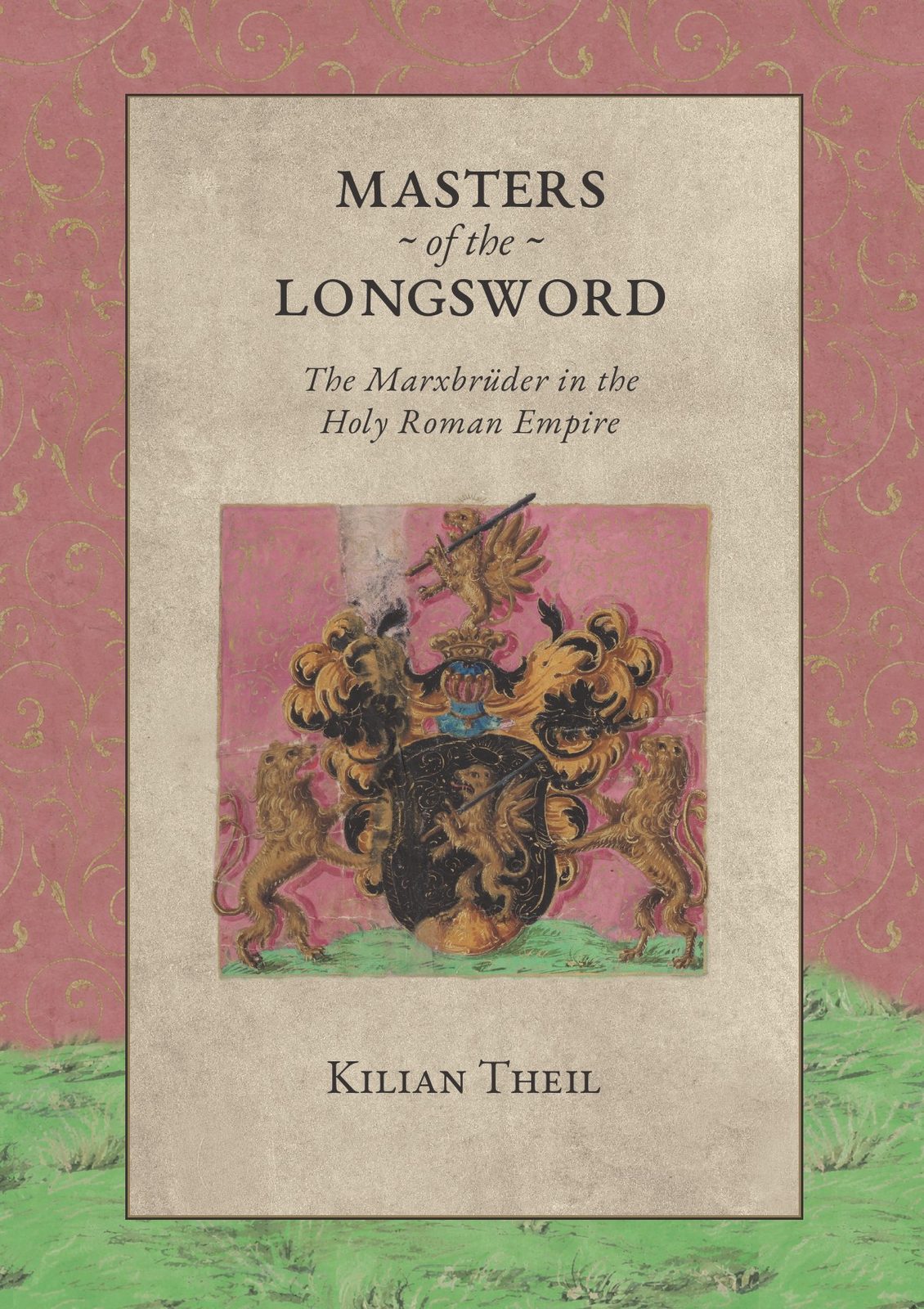
Documented since the 1450s, the Marxbrüder became the foremost brotherhood of swordsmen in the Holy Roman Empire—and for generations, they decided who could teach others the art of swordsmanship.
From their base in Frankfurt, they built an institution that stretched across central Europe: a network of fencing masters who instructed and examined candidates, enforced a monopoly granted by successive emperors, and fought rivals in council chambers as fiercely as on the fencing floor. Among their ranks were figures of lasting fame, including Hans Talhoffer, one of the most prominent fencing masters of the Late Middle Ages.
Masters of the Longsword is the first comprehensive history of this remarkable brotherhood. Drawing on largely untapped archival sources from Frankfurt, Basel, Prague, and Vienna, it recovers the Marxbrüder’s long-lost coat of arms of 1541, maps the trades and origins of over 300 masters, and follows their bitter rivalry with the Federfechter to their eventual decline. That this institution was built and sustained for over 250 years not by nobles or soldiers but by craftsmen makes its story all the more compelling.
Although the Marxbrüder are almost entirely forgotten, their legacy endures: they are a key reason why the longsword is so thoroughly documented and today practiced again by thousands of historical fencers.
“The story of fencing, a much-needed one. Written in a very approachable way, it’s a must for every HEMA library.”
— Martin Fabian
Details
Edited by Jacob H. Deacon · Myrica Press, Frankfurt am Main · Published 31 October 2026 · 308 pages · hardcover, full color · ISBN 978-3-9829185-0-1 · List price €39.90 (Germany)
Where to buy
Europe
- Blackwell’s (UK, delivers to the EU)
North America
- Amazon.com (pre-order)
- Books-A-Million (pre-order)
- Bookshop.org
Libraries: Please order through your usual supplier by ISBN; the book is distributed internationally via Ingram. If your supplier cannot source it, get in touch.
Open data
- Marxbrüder Master Dataset, 1491–1716: doi.org/10.5281/zenodo.20834816
- Vector reconstruction of the 1670 arms: doi.org/10.5281/zenodo.20834693
- Transcription of the council petitions causa Federfechter, ISG FFM H.18.02, Nr. 19: doi.org/10.5281/zenodo.20818283
Further reading on this blog
- Finding the Lost Marxbrüder Arms of 1541
- Baroque Bombast and Imperial Grace
- Religion and Revolution
- Hidden in the Holdings
- Mapping the Marxbrüder
- Rise of the Griffon
Corrigenda
- p. 126, n. 82: I misinterpreted the archival unit HHStA, RHR ConfPriv 48 as an “enigmatic ‘Faber’ fencing society.” In fact, it is the box that holds both 48-3-1 (Marxbrüder) and 48-4-1 (Federfechter). Its catalogue title, “Faber-Fechtergesellschaft,” does not name a society but marks an alphabetical range, from “Faber” (48-1, Christoph Faber) to “Fechtergesellschaft”; 1365 is simply the earliest date in the box. In my defense, the catalogue joins the two words with a hyphen, which makes them look like a single name; an en dash (Faber–Fechtergesellschaft) would have marked a range. Please mind your dashes.